Individual Work
Time: 2025.4 - 2025.6
Type: Board Game
Software: Photoshop / Figma
Summary→
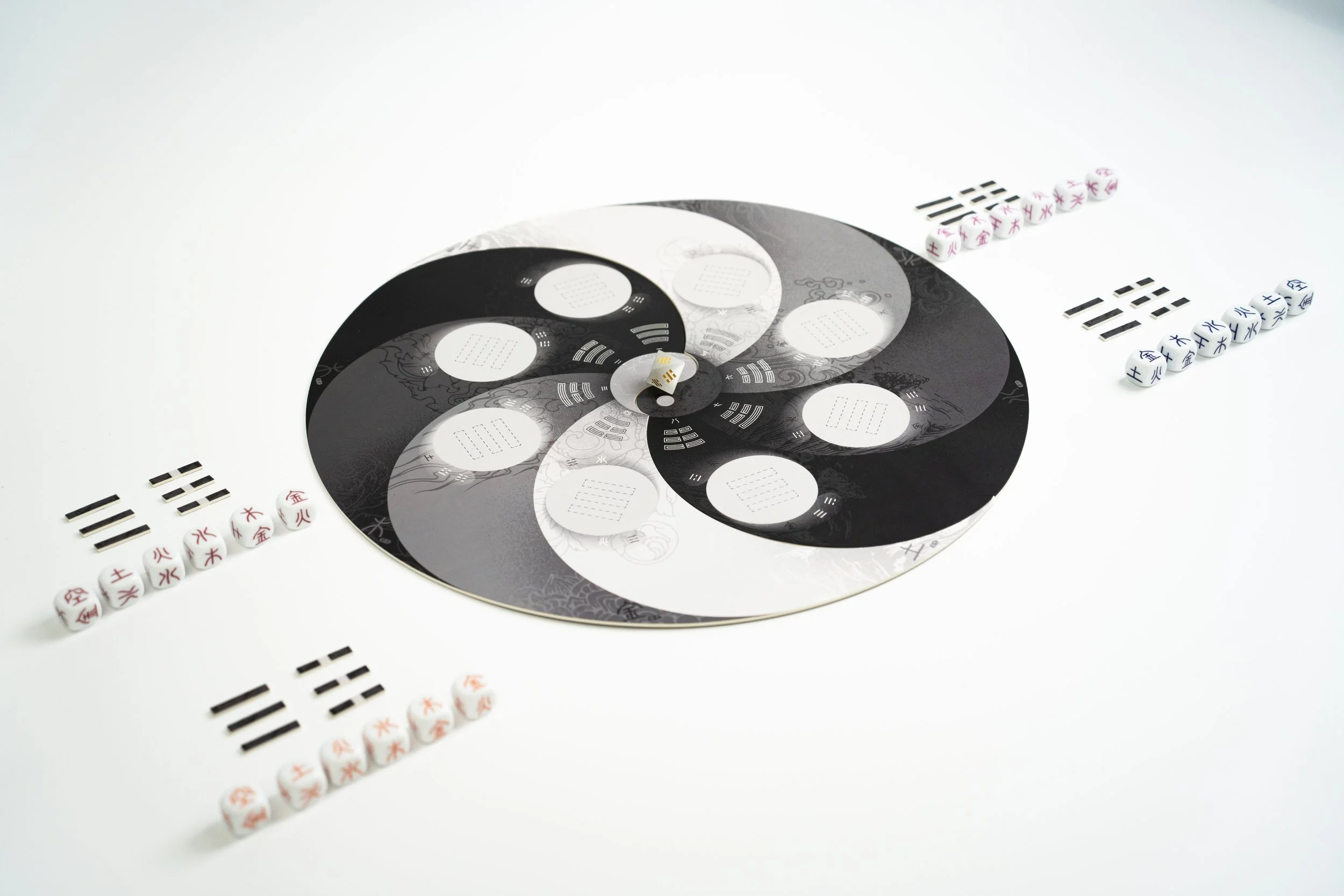
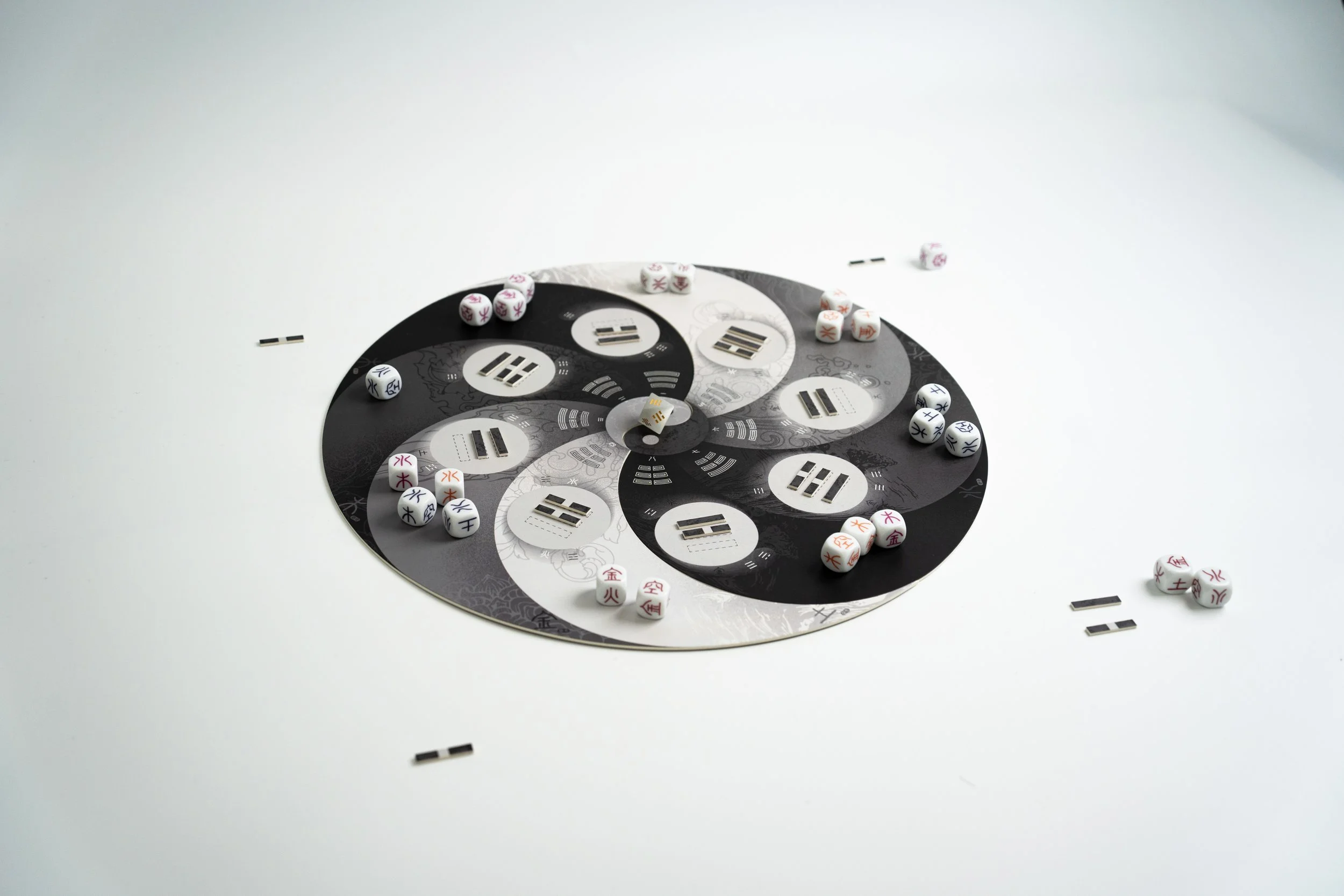
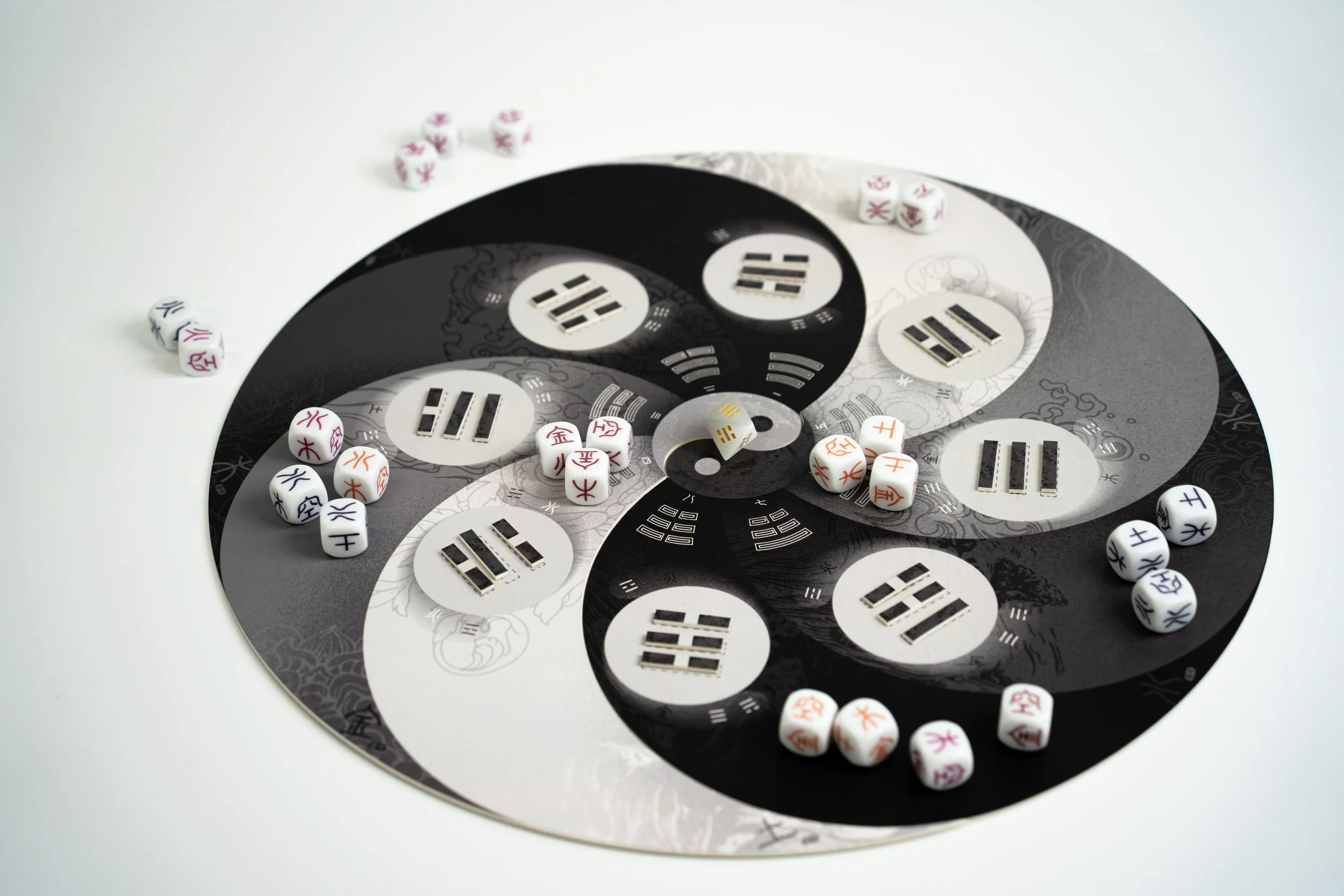
Trigram Deduction is a light strategy and educational board game. Players take on the roles of celestial masters deciphering the secrets of the cosmos, collaboratively constructing the Later Heaven Bagua. During the process, they must pay close attention to the Five Element relationships among the trigrams and plan their moves in advance to draw as much “Qi” as possible from the laws of heaven and earth. With ever-changing trigrams and the intricate cycle of generation and restraint among the Five Elements, will the masters ultimately unveil the mysteries of fate and claim victory? Let’s find out.
VIDEO
Inspiration
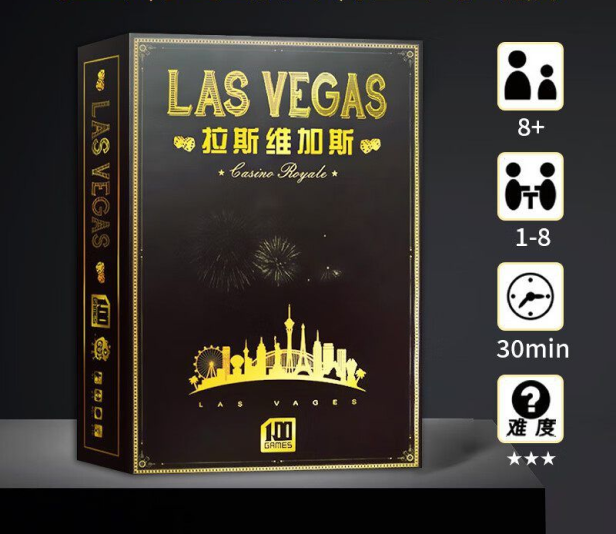

At an event held by our university's board game club, my friends and I were introduced to the game Las Vegas. The dice roll distribution and placement in different areas to create collisions between players really captivated me. We expanded on the dice roll distribution mechanism from Las Vegas and incorporated it into the Bagua deduction process. We hope this fusion of the two will provide players with a unique gaming experience.
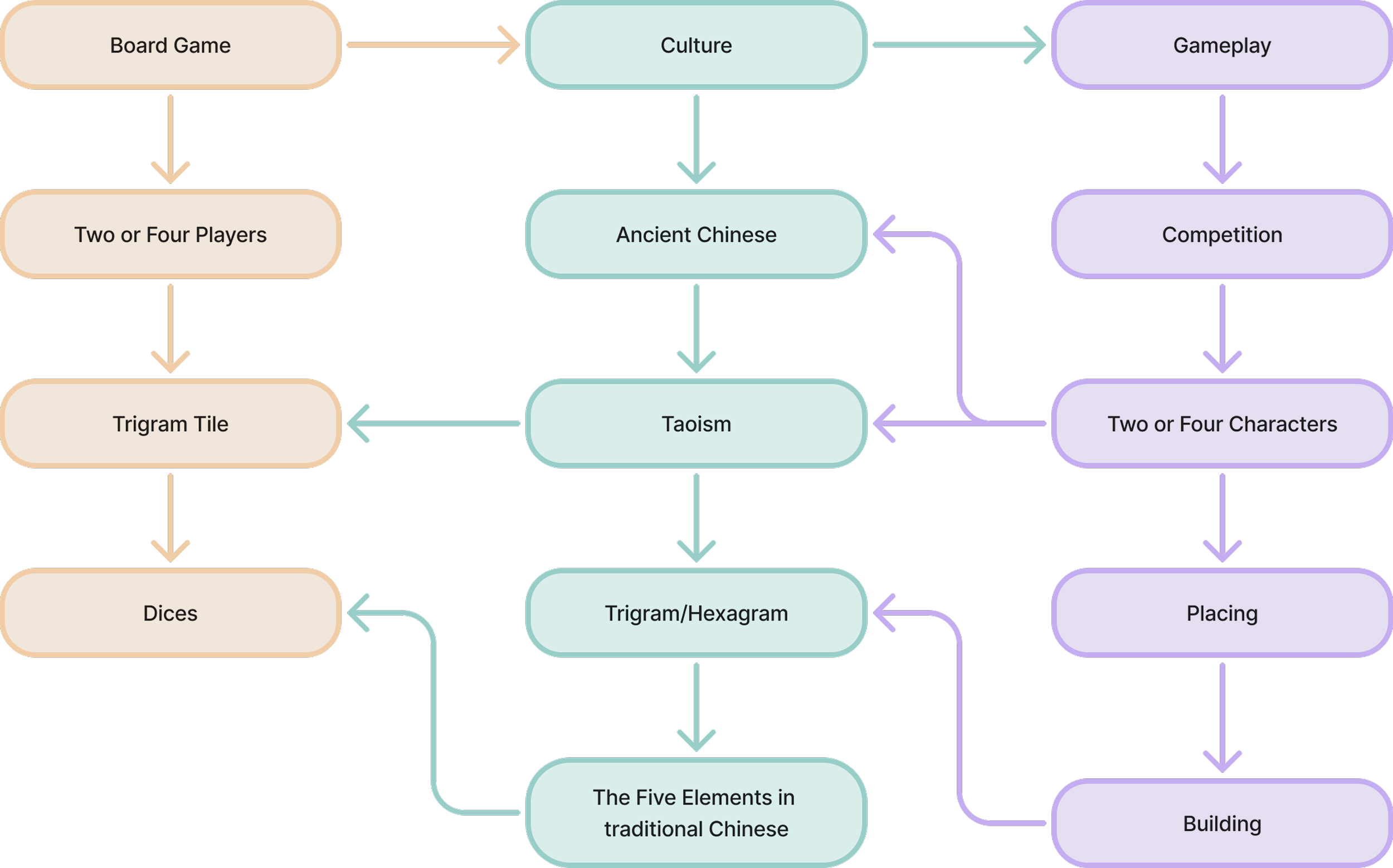
Games are a great medium for spreading culture. In my spare time during college, I researched the Six-Line Divination and the Five Elements and Eight Trigrams based on my own interests. However, most modern people know very little about these ancient Chinese divination methods. Therefore, I hope this game will not only provide players with fun and playability, but also allow them to learn about ancient Chinese divination knowledge and understand how the ancients viewed the world.
Core Gameplay
Setup
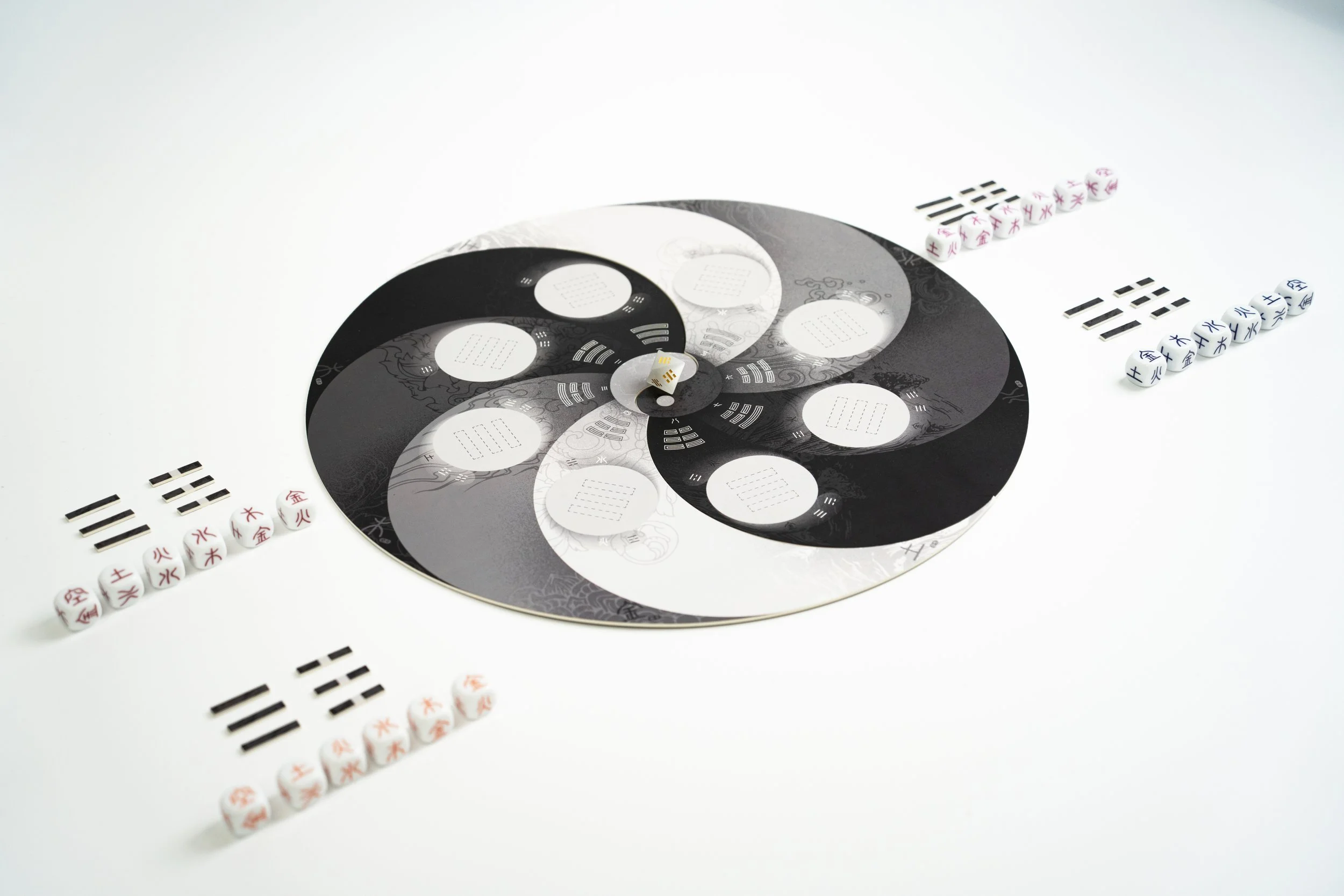
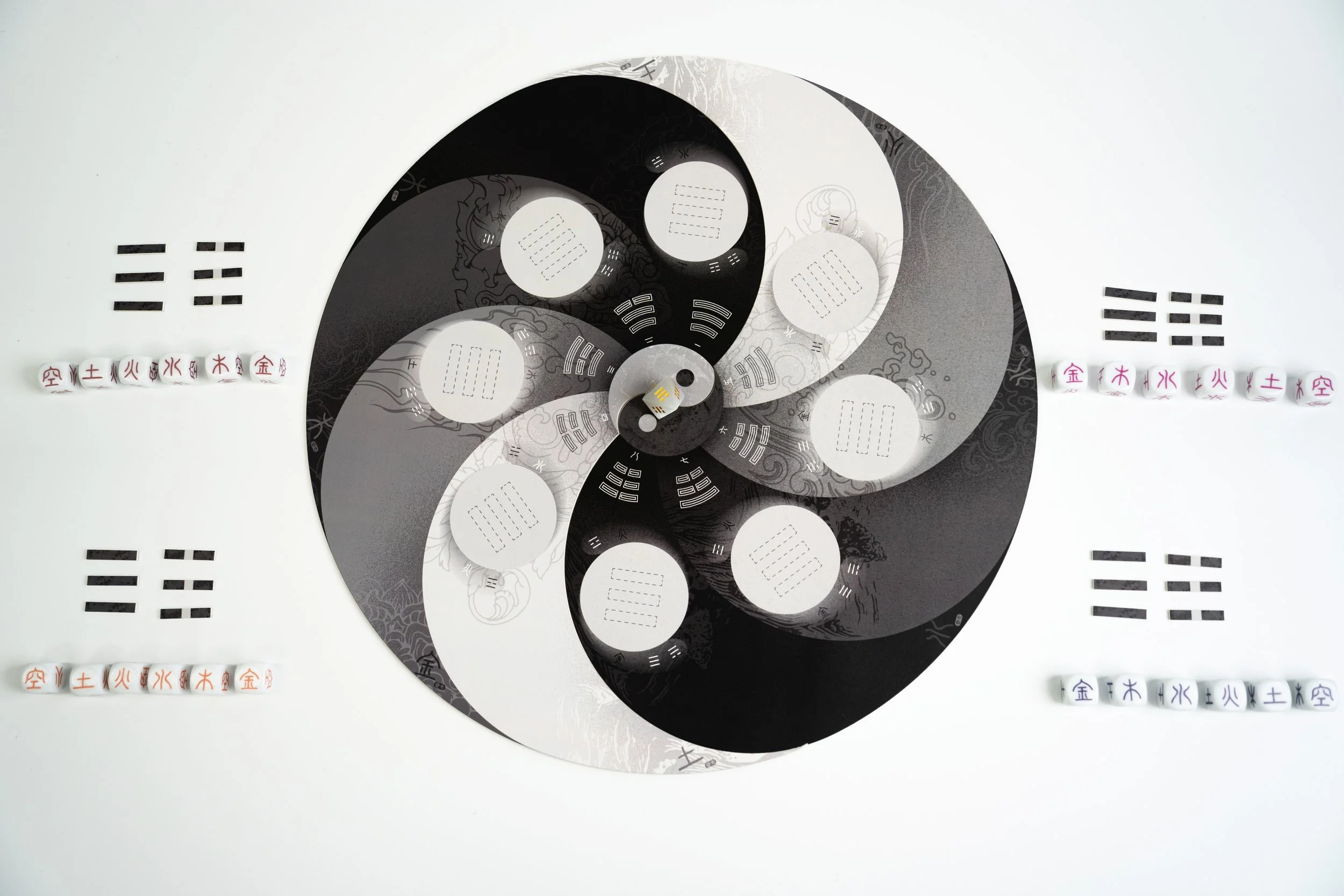
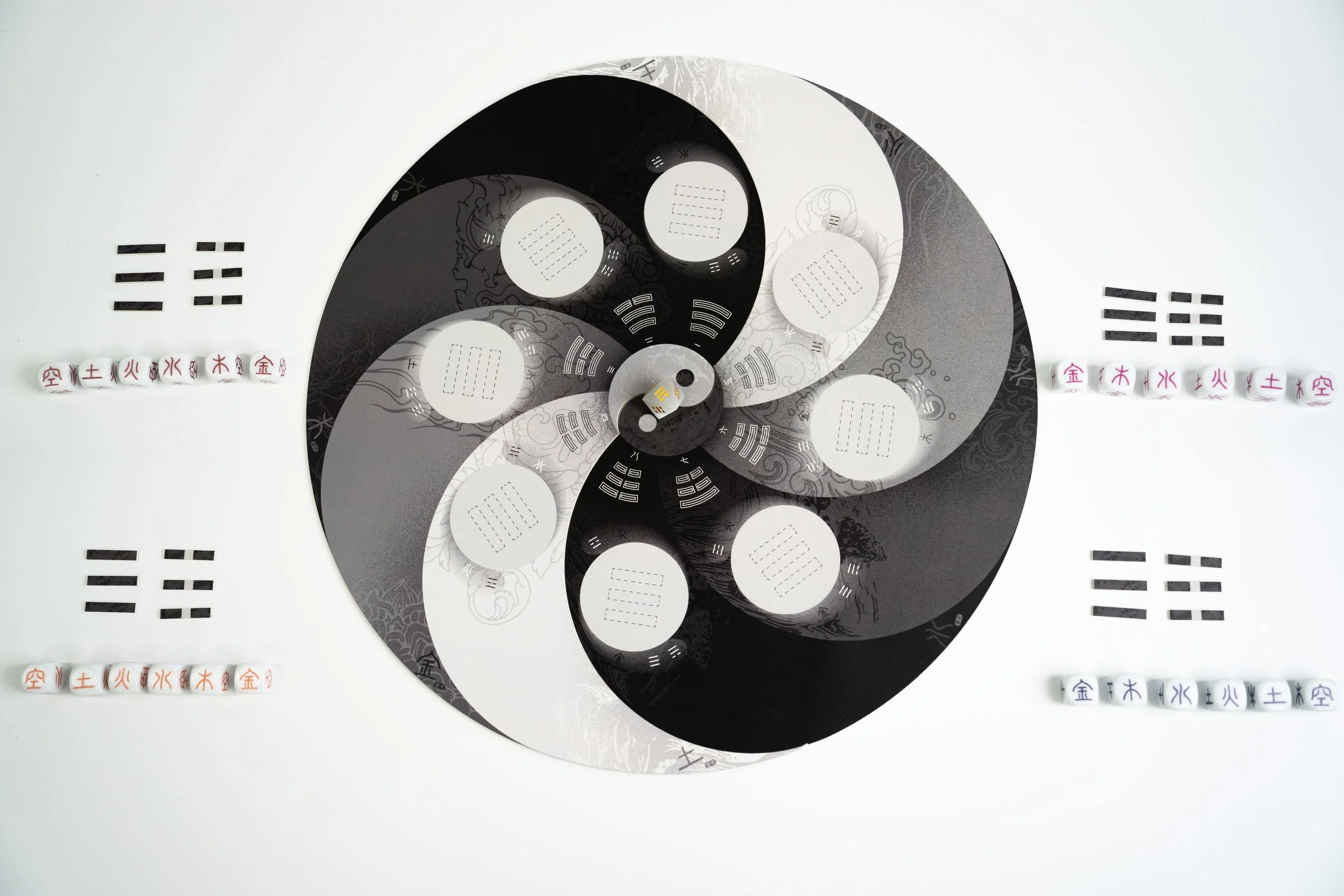
Each player rolls six dice (24 total), including one eight-sided Bagua die and three Yin plus three Yang dice (12 each). The game supports two or four players, with each choosing one of eight seating positions.
Research
Length: 30 mins
Age: 13+
Player: 2 or 4
Inspiration and Research
Expansion and extension of board game mechanics
Reasons for choosing the theme of traditional Chinese culture
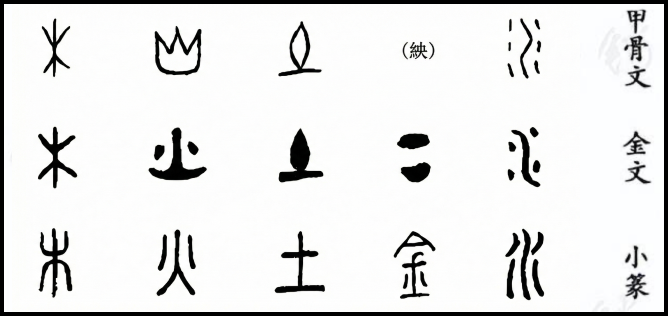
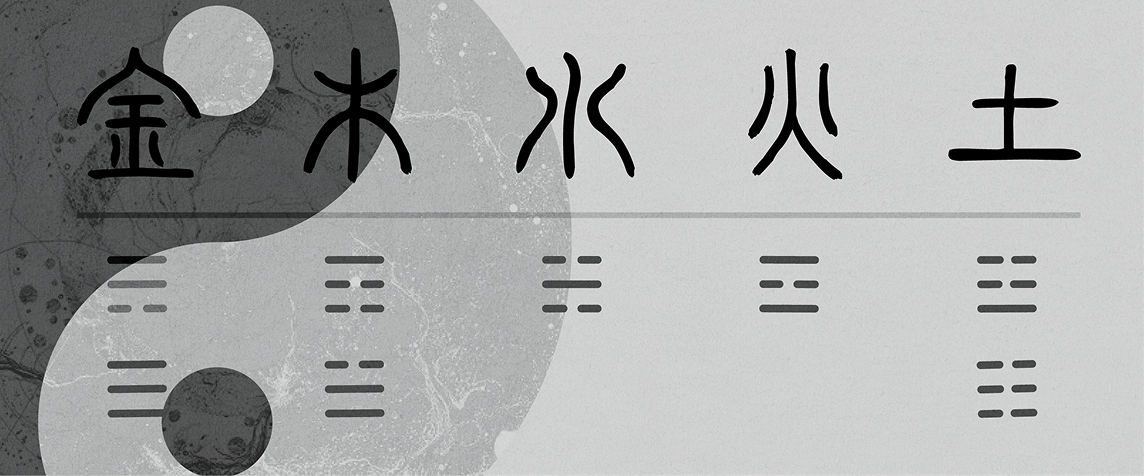
In the symbol design phase, I first used seal script characters to represent Wood, Fire, Earth, Metal, and Water. Later, seeking a more intuitive yet ancient feel, I experimented with Oracle Bone and Bronze Inscription–inspired forms. However, feedback showed these pictographic symbols were harder to interpret. To balance clarity and style, I ultimately returned to using seal script characters to represent the Five Elements.

The Origin and Formation of the Bagua
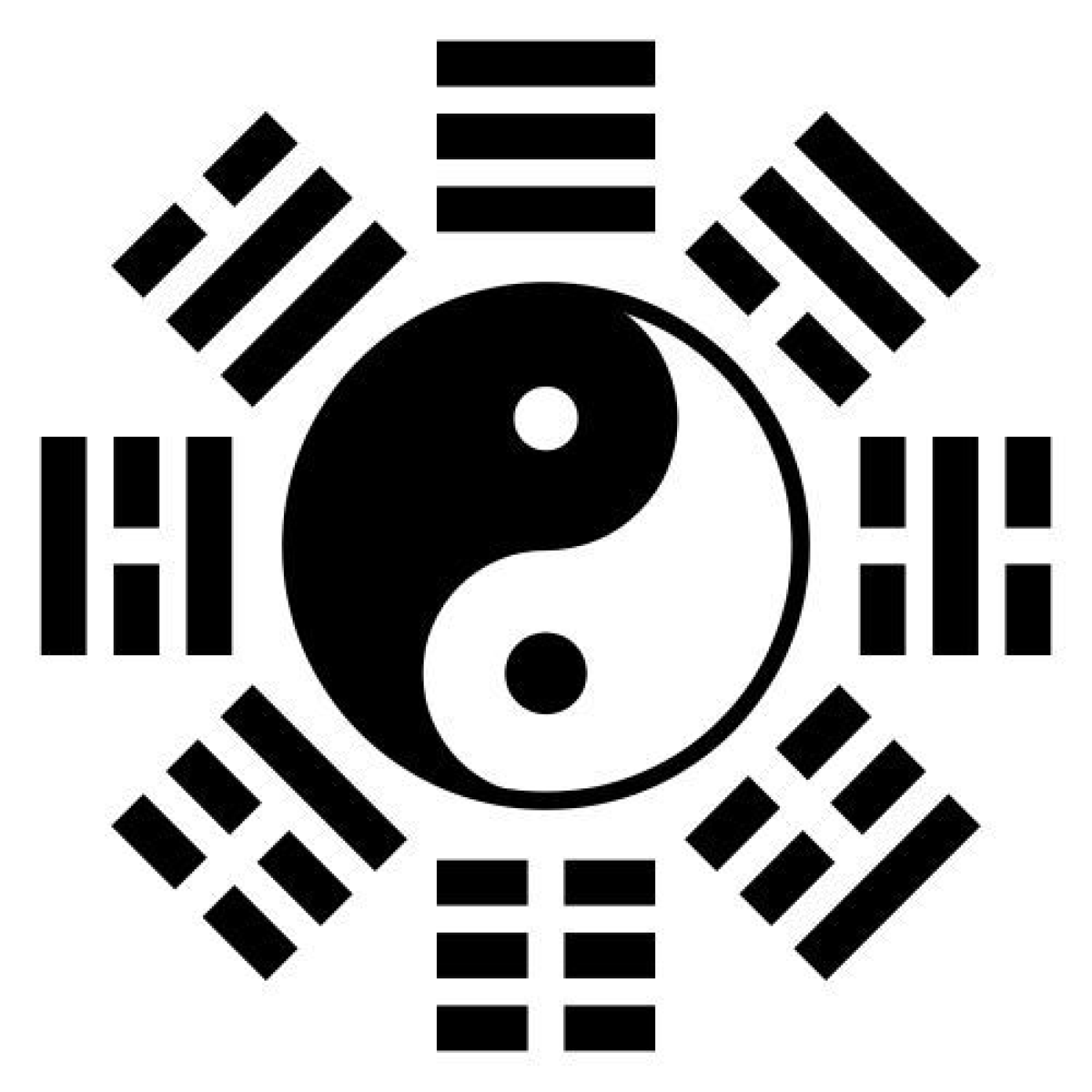
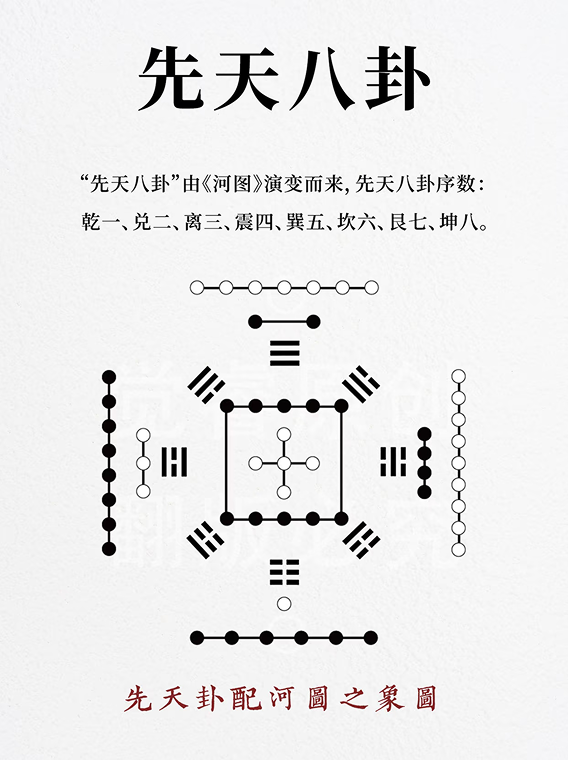
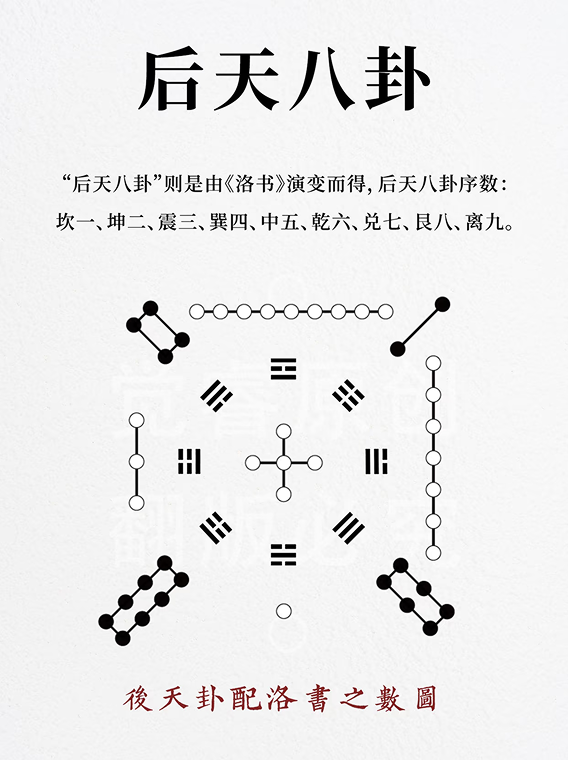
The Bagua is divided into the Earlier Heaven Bagua and the Later Heaven Bagua: the Earlier Heaven Bagua is derived from the He Tu diagram, while the Later Heaven Bagua comes from the Luo Shu diagram.
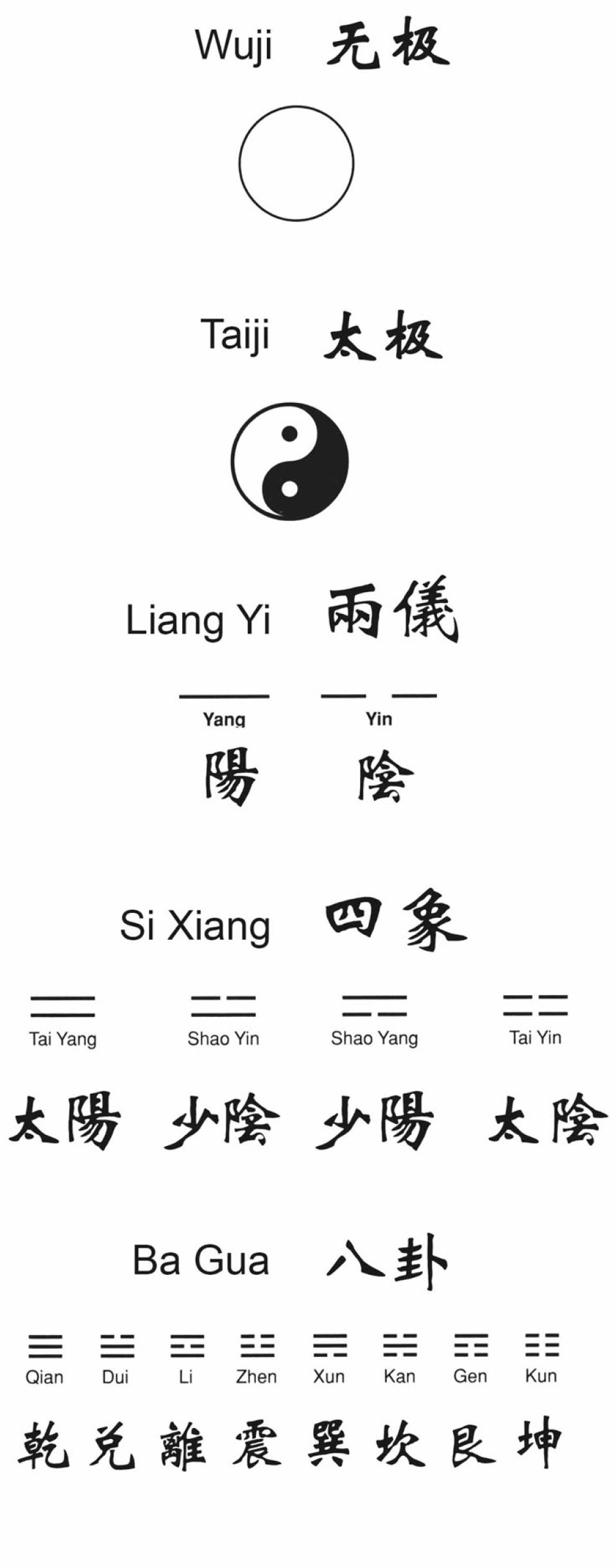
The formation of the Bagua can be summarized as: “Wuji generates Taiji; Taiji generates the Two Modes; the Two Modes generate the Four Symbols; the Four Symbols generate the Eight Trigrams.”
The Two Modes are Yin and Yang;
The Four Symbols are Greater Yang, Greater Yin, Lesser Yang, and Lesser Yin;
The Eight Trigrams are Qian, Dui, Li, Zhen, Xun, Kan, Gen, and Kun.
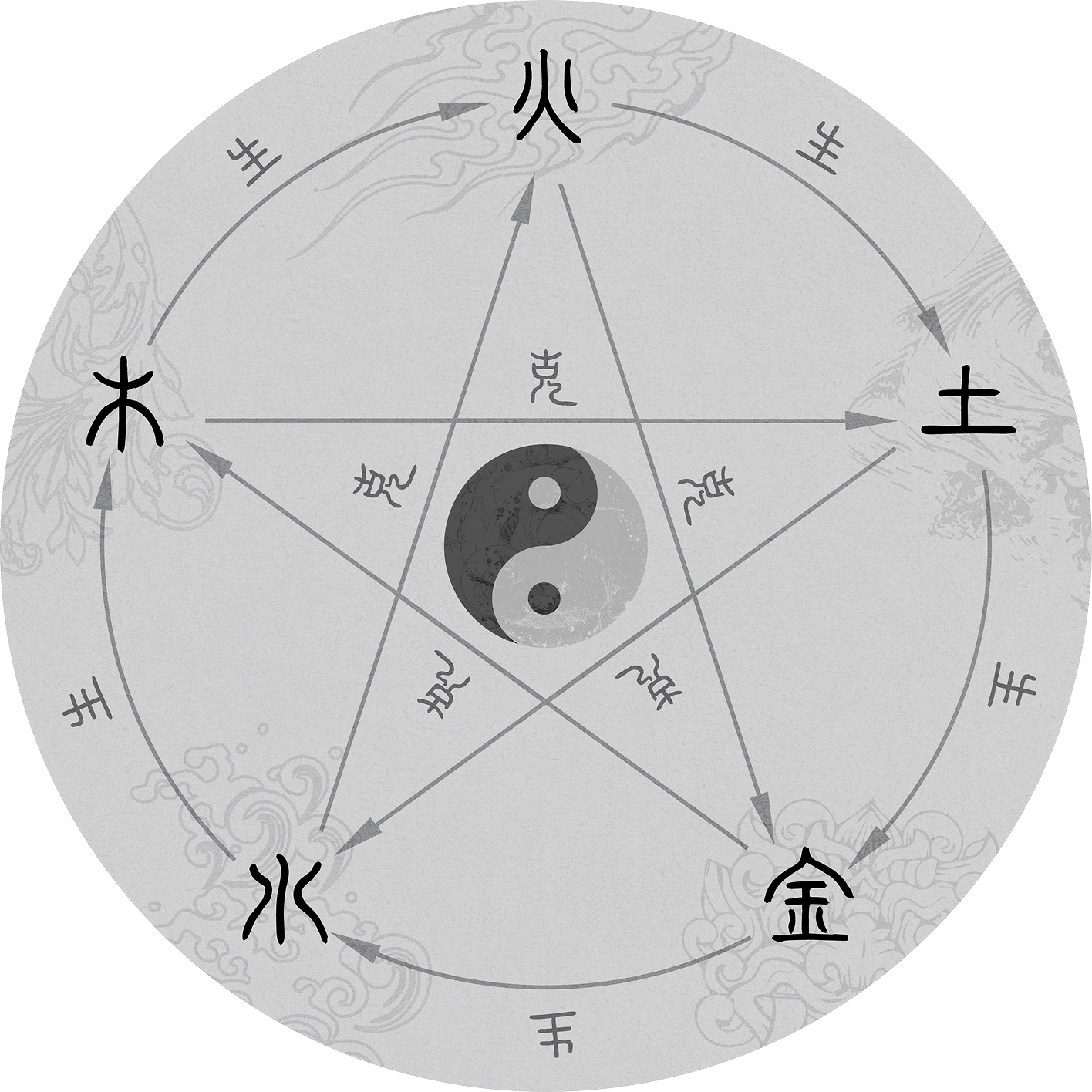
Each trigram also corresponds to one of the Five Elements—Metal, Water, Wood, Fire, or Earth—and there are generative and restraining relationships among the elements. This interconnects all trigrams, making each trigram no longer isolated. These Five Element relationships also illustrate the flow of energy between trigrams, providing abundant creative space for designing game mechanics.
Beginning
The player with the highest-ranked trigram begins, rolling the dice once and predicting the highest number of faces. Whoever guesses correctly starts the game clockwise.
Round
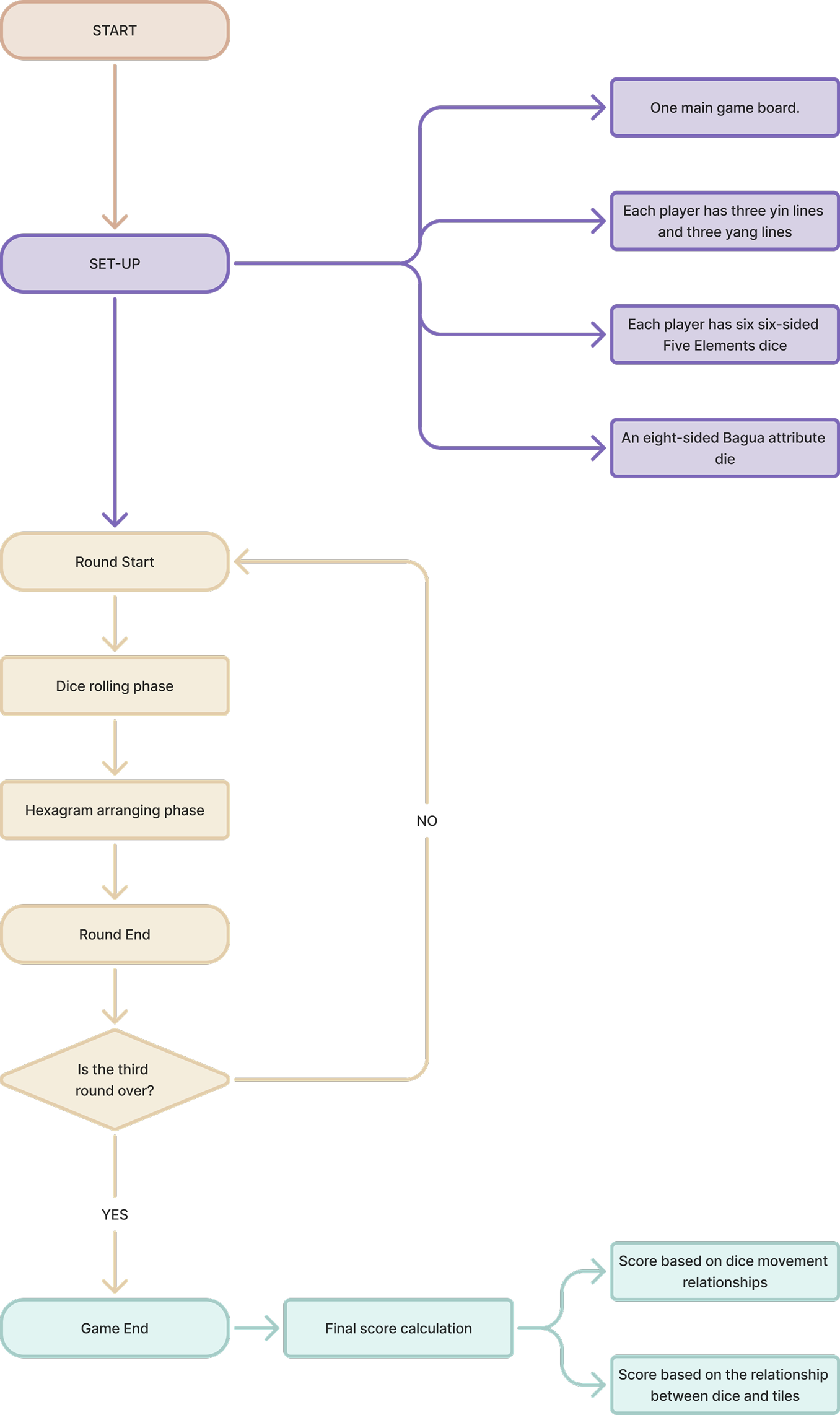
At the start of their turn, players roll the dice. Any element showing a face of 2 or higher can be placed on the Later Heaven Bagua tiles—at least one element must be placed (if all six rolls are different, this step can be skipped). Multiple elements may be placed, but never on Xiantian Bagua tiles. A blank face counts as any of the Five Elements. Each tile also forbids one specific element, and each player can place only one element per tile; placements do not interfere with others.
If a subsequent roll matches an element already placed, the player may add to it (e.g., if you have 2 Waters and roll 1 Water, you now have 3).
After all rolls, the player with the fewest dice left places Yin and Yang lines first, freely on the dotted lines. If tied, players guess whether the eight-sided die shows Yin or Yang; a correct guess goes first, incorrect last. Players then roll again to place more Yin and Yang lines. This cycle continues until all dice are placed.
Settlement
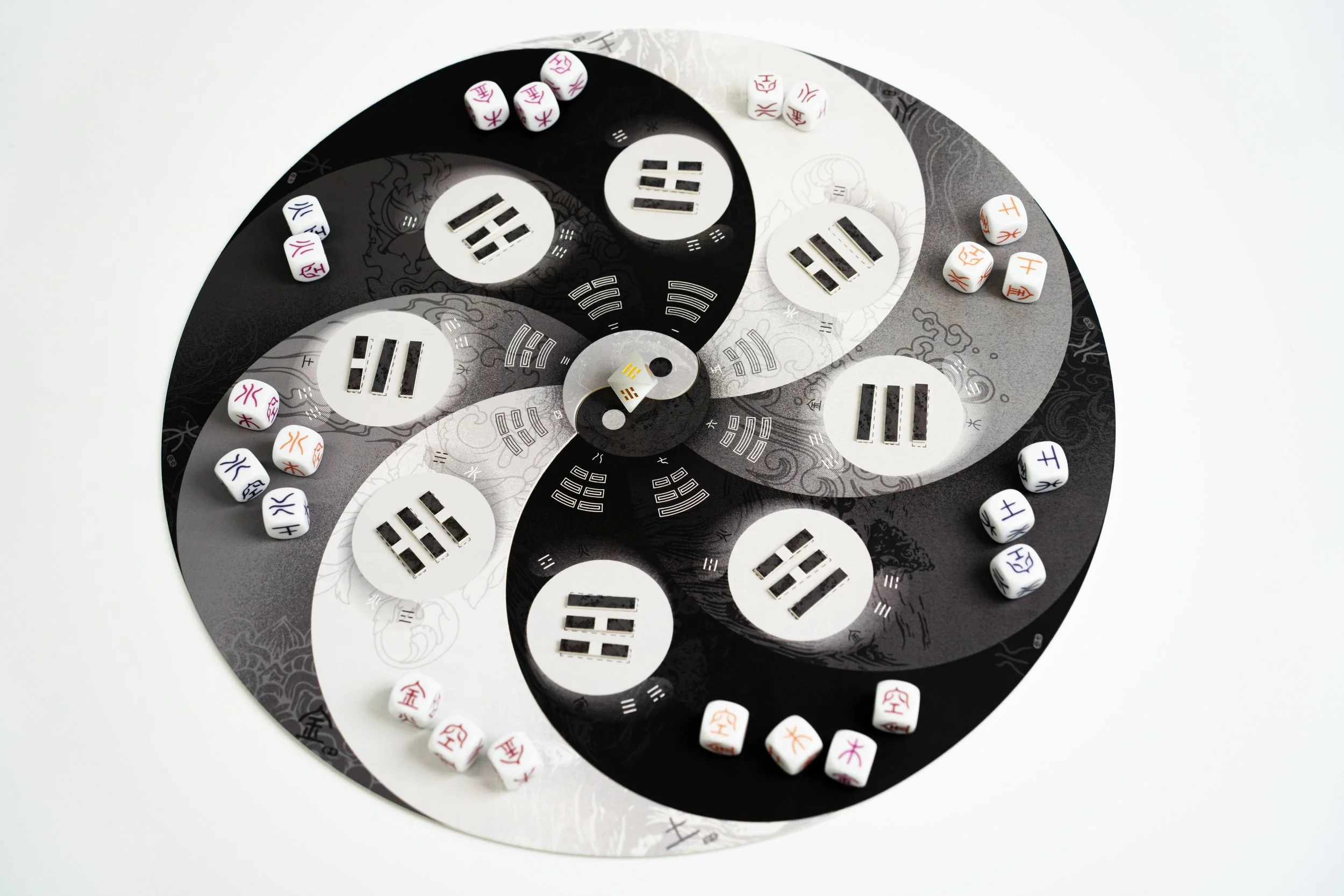
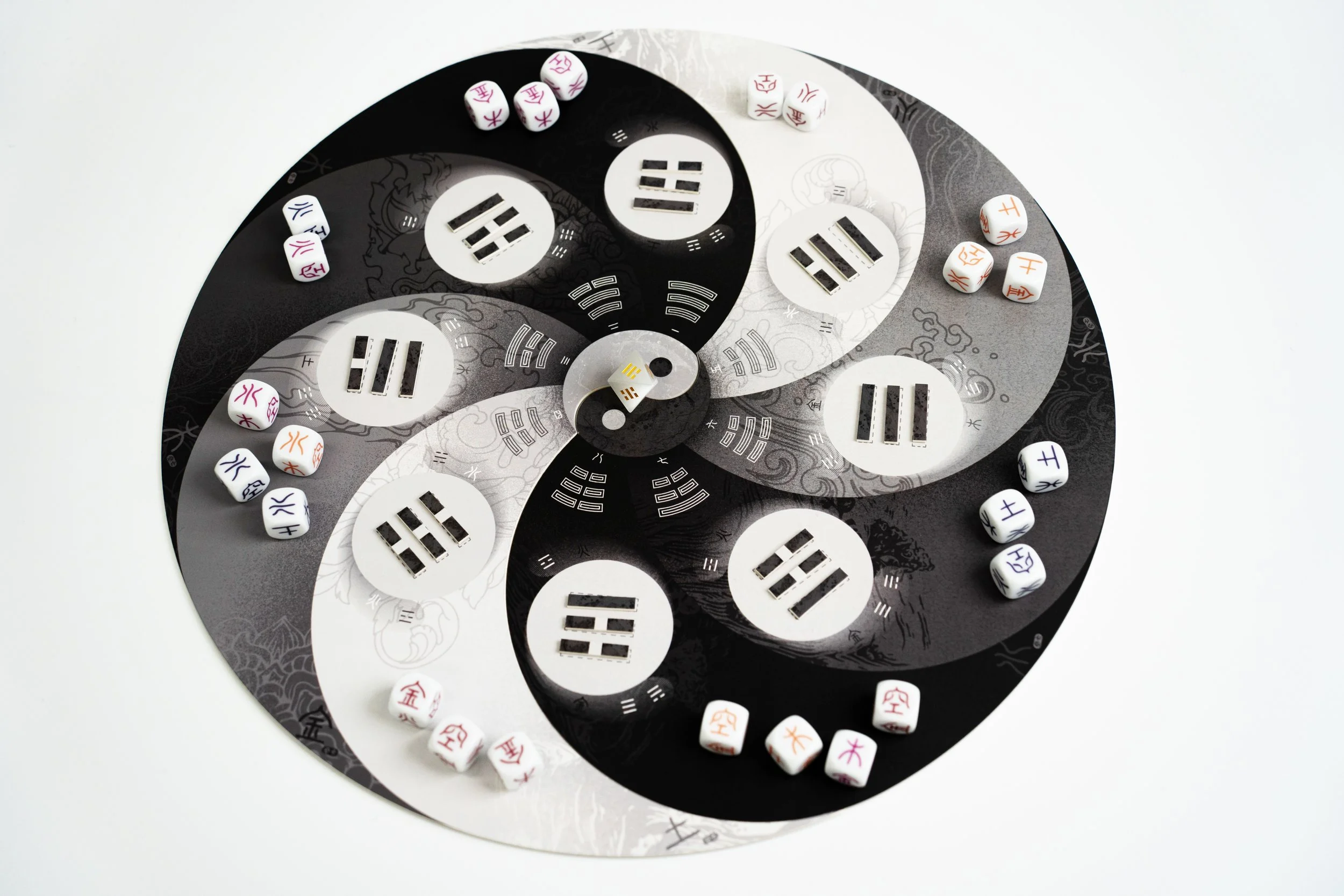
Calculate the Five Elements for each plot’s hexagram to form the Postnatal Bagua. Remove any dice restricted by the Postnatal Five Elements. Then, check for a mutual generation relationship between the Innate and Postnatal Bagua in the same direction:
If A generates B, dice in area A flow to B, calculated using B’s Five Elements.
If the Innate Bagua generates the Postnatal Bagua, all dice are pushed off the board.
If the Postnatal Bagua generates the Innate, Postnatal dice move to the Innate side.
If no generation relationship exists, dice remain in place.
Scoring: Matching a dice’s attribute to the plot’s attribute doubles its points. Remaining dice score 1 point each. Pushing dice inward doubles the score, and if attributes match, it doubles again. The highest total score wins.
Development Process
Ver.1
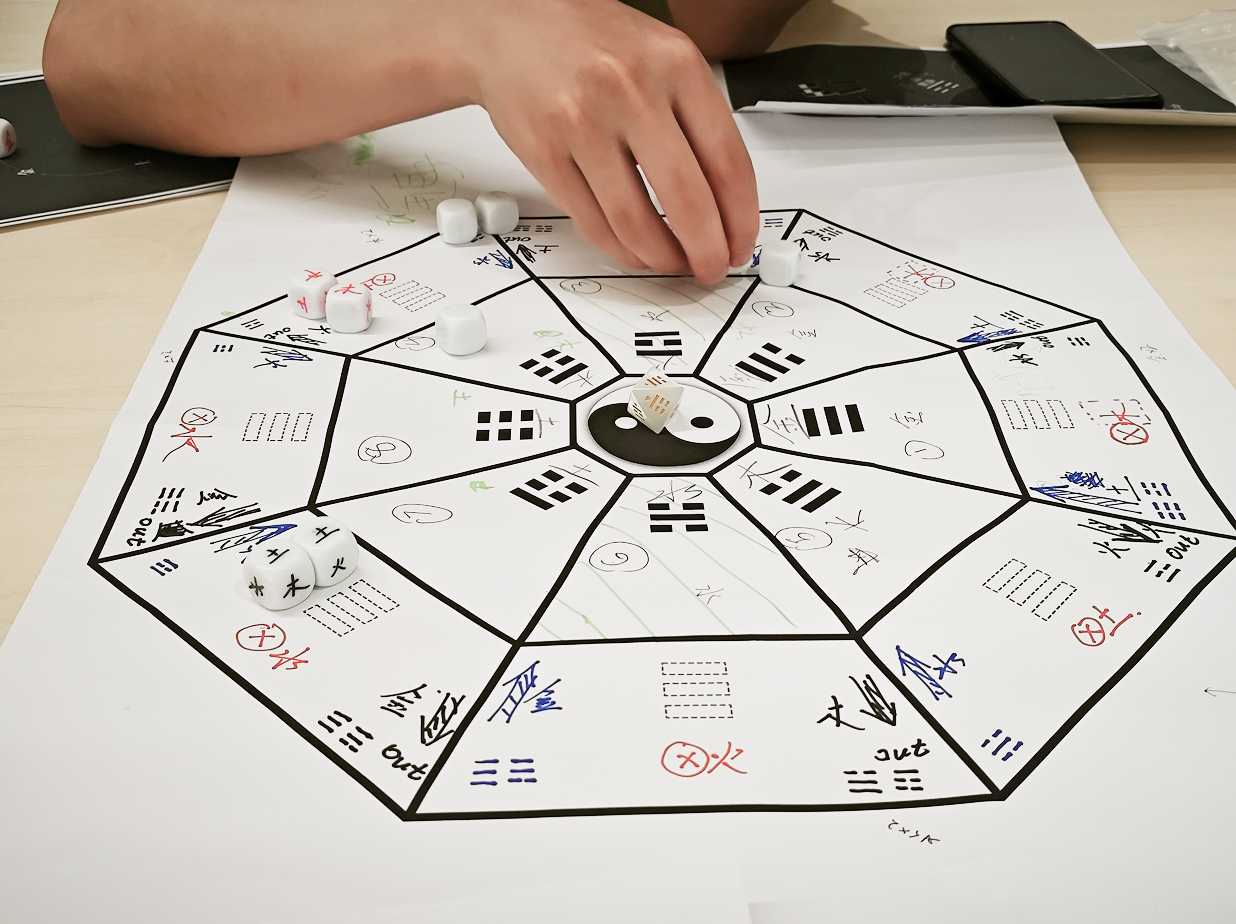
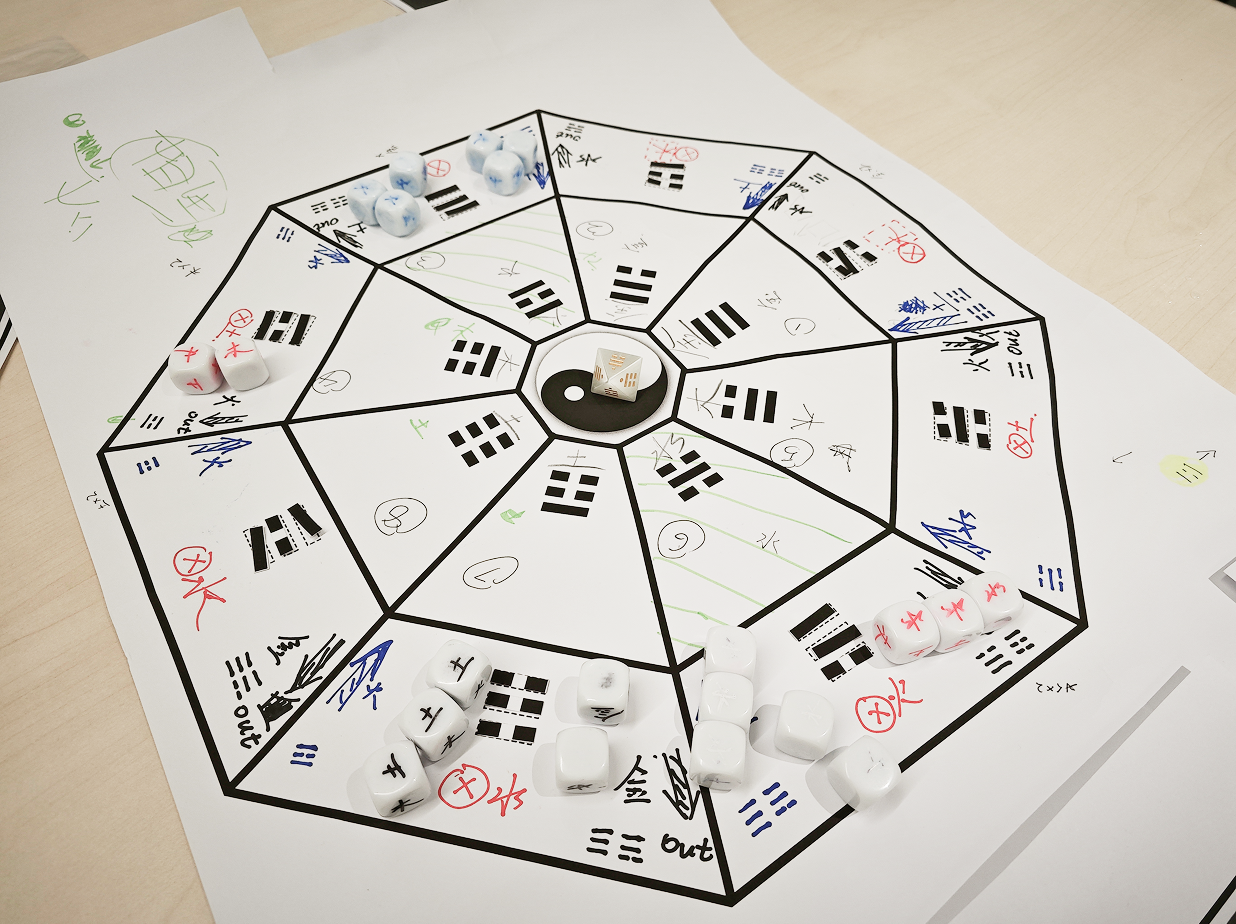
Brainstorm
Game Flow
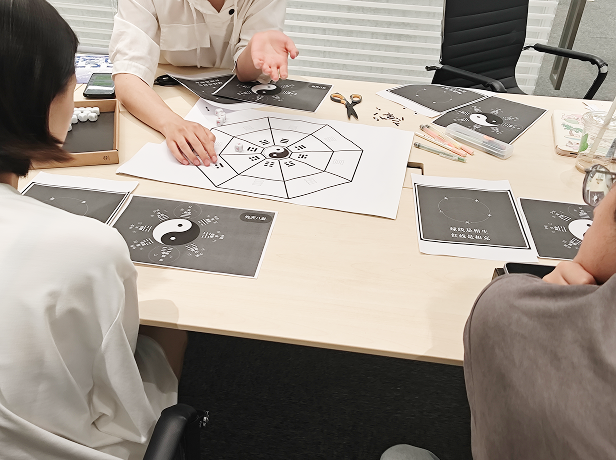
However, this first playtest also revealed two significant issues:
The rules for generating the trigrams are overly complex. Players with little to no knowledge of trigrams and the Five Elements find it difficult to understand and memorize the rules. The learning curve is steep, the cognitive load high, and players must constantly refer to the rulebook to check the correspondence between trigrams and the Five Elements.
Competition between players lacks intensity and excitement. The game board is divided into the Earlier Heaven Bagua and Later Heaven Bagua regions. The Earlier Heaven Bagua forms naturally and exists at the start of the game, while the Later Heaven Bagua is constructed later and carries uncertainty. To secure stable points, players often place their dice in the Earlier Heaven region, resulting in diminished confrontation and competition during gameplay.
By adding hints on the game board and simplifying the rules, the cognitive load on players can be reduced, making the game easier to understand and more accessible.
We have separated the generative and restraining relationships of the Five Elements corresponding to the trigrams. Originally, players needed to consider both relationships when placing dice and during final scoring. Now, players only consider restraining relationships when placing dice and generative relationships during final scoring.
In addition, we have added hints on the game board, indicating, for example, which elemental dice cannot be placed on certain spaces due to being restrained, further reducing the number of steps players need to think through.
We removed excessive restrictions on trigram generation while retaining limitations on dice placement: dice must be placed in the Later Heaven Bagua region and cannot be positioned where they are restrained by other trigrams.
Initially, the rules for generating the Later Heaven Bagua were too restrictive, resulting in low rewards and limited player agency. Therefore, we removed the restriction that allowed placement only in the corresponding row during each of the three rounds. As a result, each trigram can now appear multiple times, creating richer variations and giving players greater flexibility in their choices.
At the same time, players are prevented from placing dice directly in the Earlier Heaven Bagua to avoid confrontation and competition. However, through the energy flow generated by the generative relationships among trigrams, dice can move from the Later Heaven region to the Earlier Heaven region or be pushed off the board, losing points. This encourages players to focus more on building the Later Heaven Bagua.
Art Reference
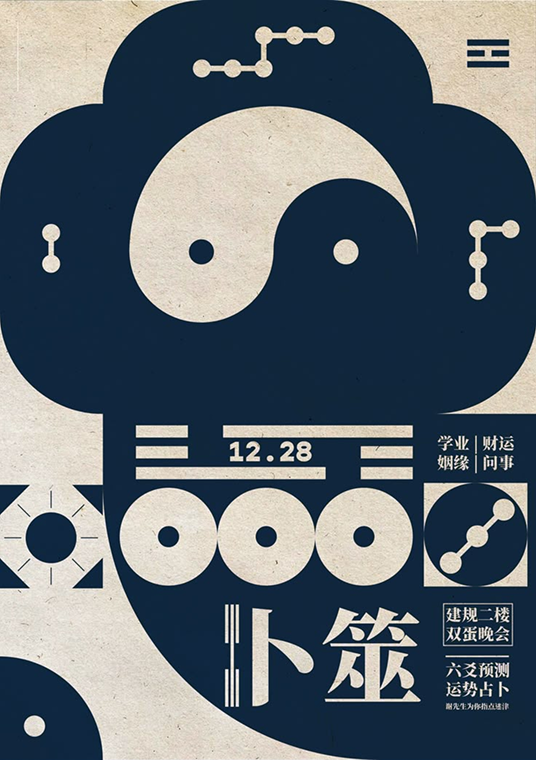
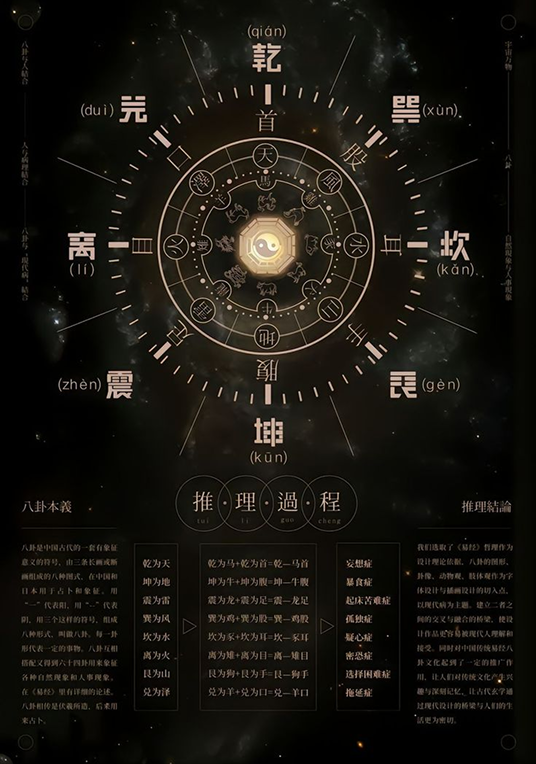
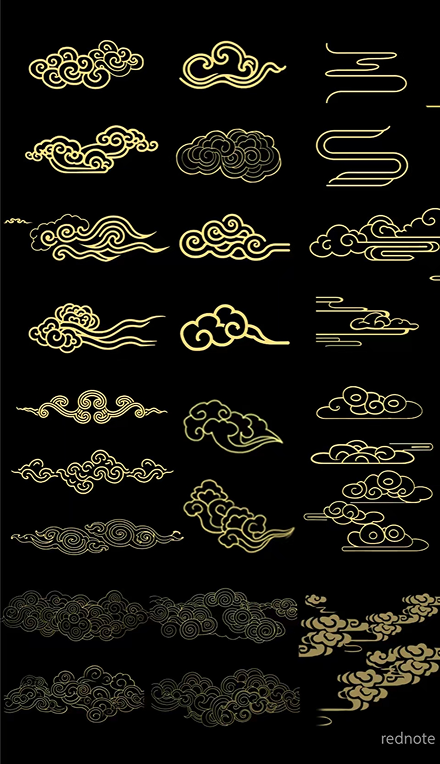
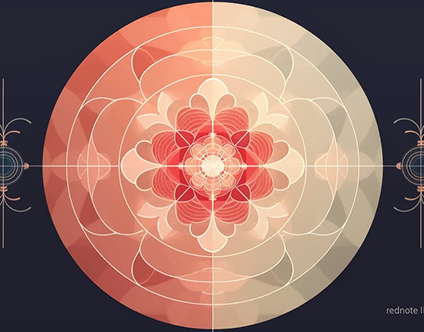
Art Iteration
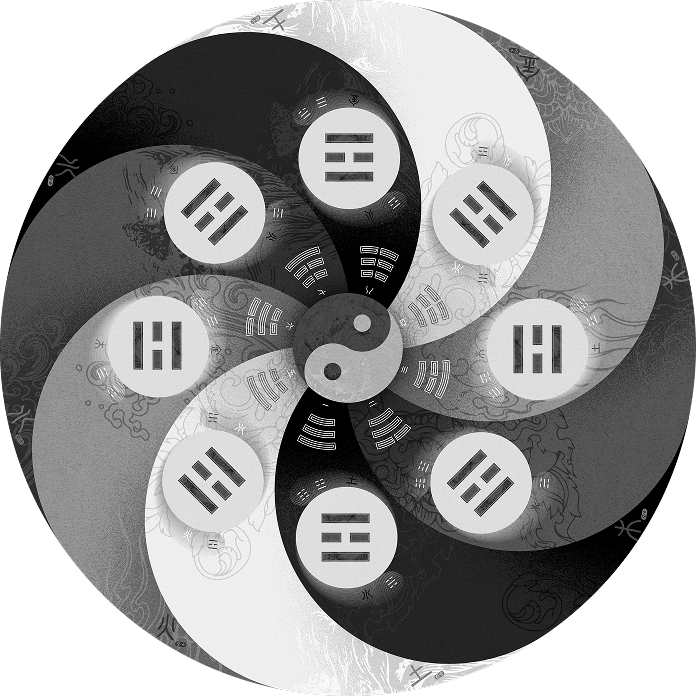
Iteration of the Bagua Disc
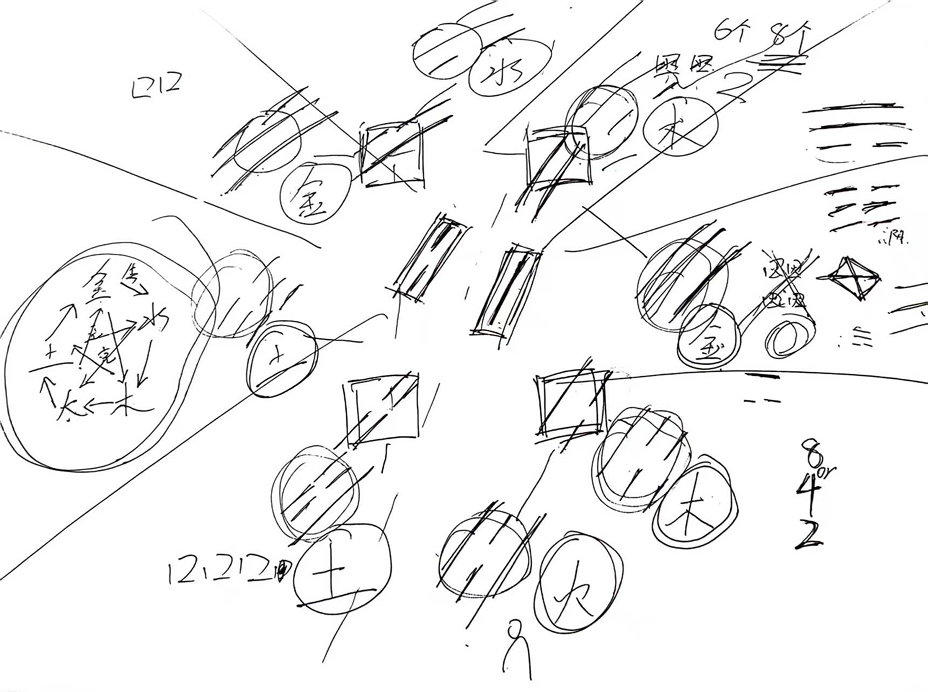
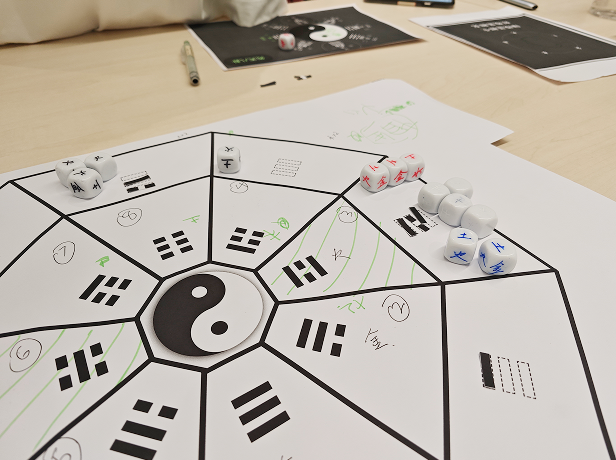
During the board game testing, my friends and I discovered that the points of strategic interaction were far more numerous than I had originally anticipated. Players could form temporary alliances or oppose each other, rather than engaging solely in the individualistic, free-for-all style I had expected.
Solution
FONT or ICON?
Ver.2
During the second playtest of the board game, the overall performance was good, with no major issues. However, a minor problem was observed: players sometimes placed their dice too densely, leaving some areas of the board unused and reducing opportunities for strategic interaction.
To address the issue of dice being placed too densely, leaving board areas unused, we revised the dice placement rules in the new version.
Version2.0
At the beginning of their turn, a player rolls dice. If two or more dice show the same Five Element, the player can place that element onto the corresponding Later Heaven Bagua tiles. At least one element must be placed per turn (if all six dice show different results, the player may skip). Multiple elements can be placed at once; if subsequent rolls include the same element as already placed, it can be added (e.g., if there are 2 Water and 1 more Water is rolled, it becomes 3 Water), continuing until all dice are used.
Version2.1
Players may roll dice a maximum of three times per turn, with the game ending after three rounds. Any dice remaining in hand at the end of a turn are discarded. This encourages players to place dice actively rather than endlessly rolling for an ideal result.
Version2.2
If all six dice show different numbers, the player must choose one to place. Blank faces can be treated as a copy of any rolled face for that turn, and at least one element must be placed each round.
Version2.3
Starting from the second roll, dice of the same element cannot be placed on a tile where that element has already been placed, meaning each tile may only receive one placement per player.
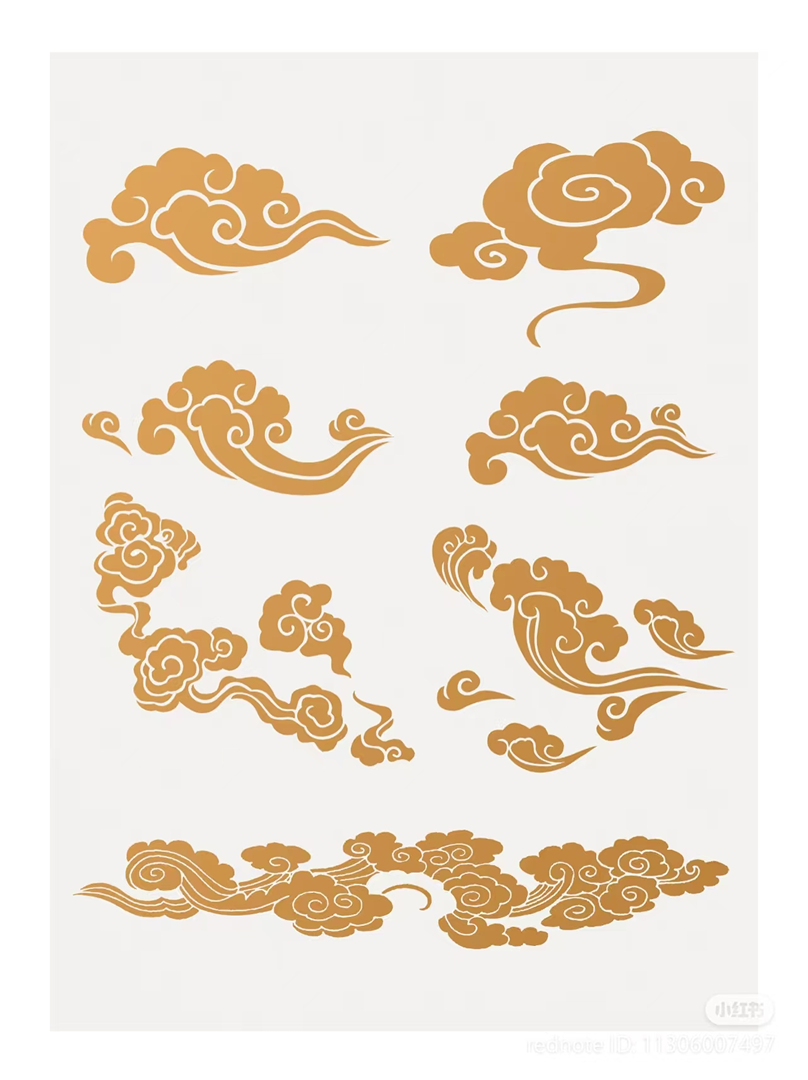
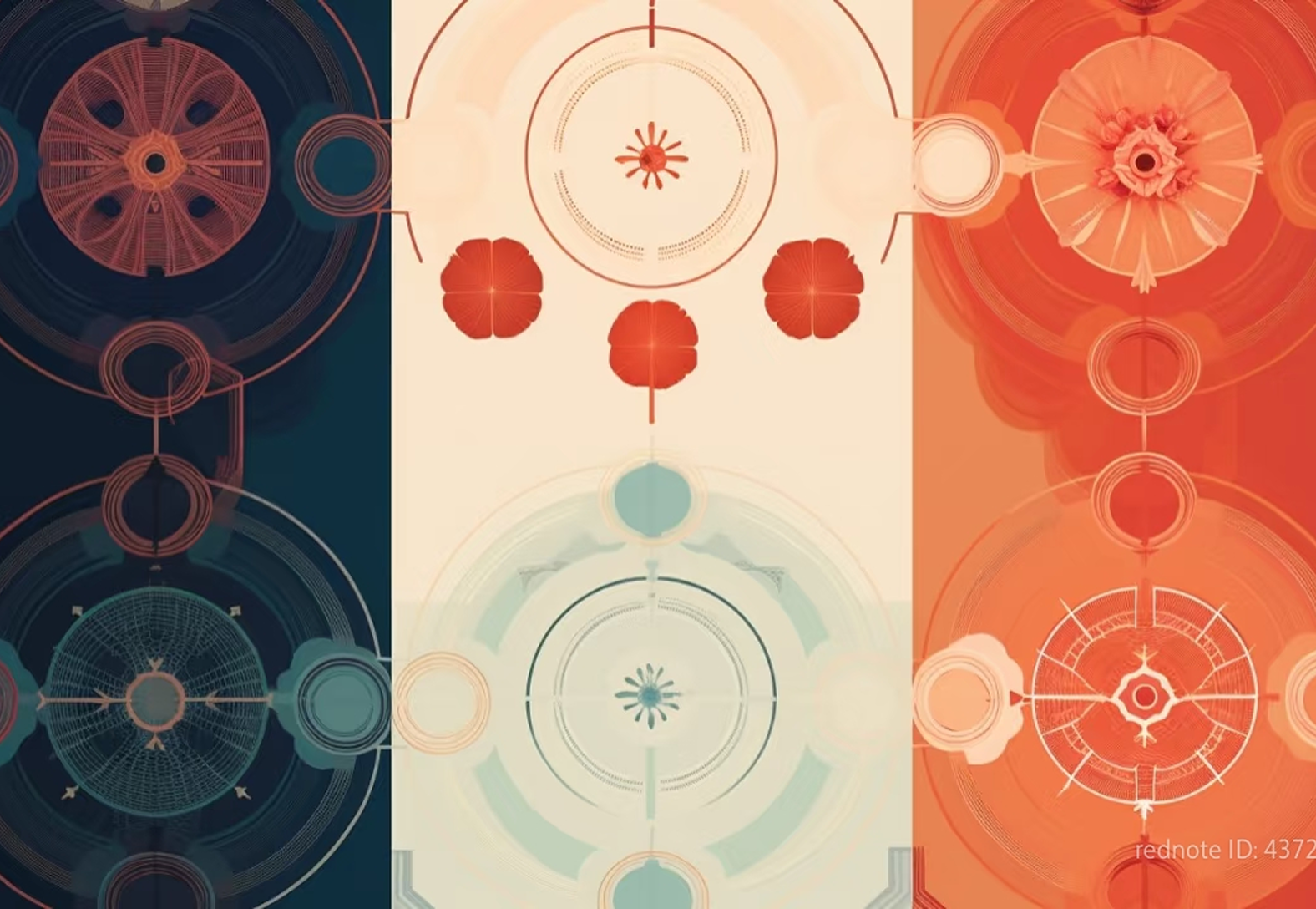
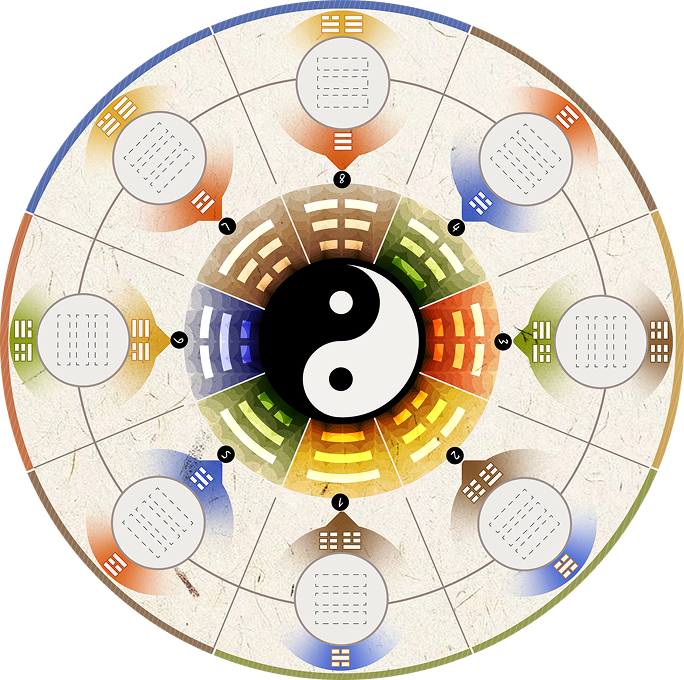
In my initial design, I used distinct colors to represent the Five Elements—red for Fire, blue for Water, and so on—creating an immediate visual link between color and meaning. Yet, when completed, the design felt overly vibrant and chaotic, as the contrasting hues clashed and diminished the elegance and refinement I intended.
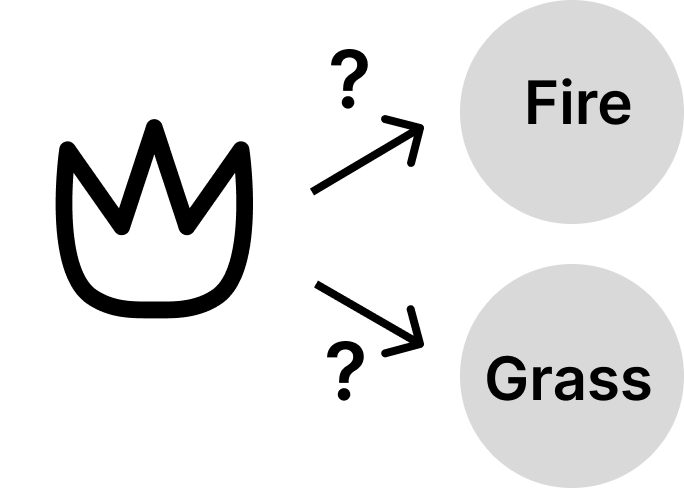

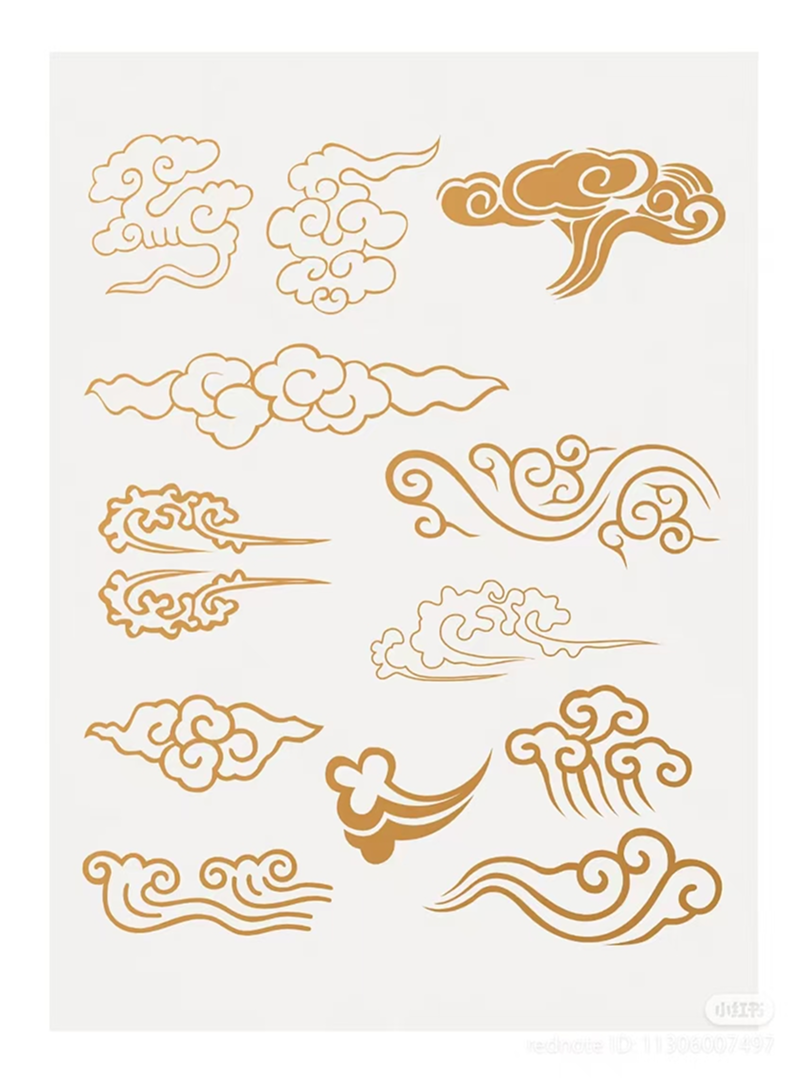
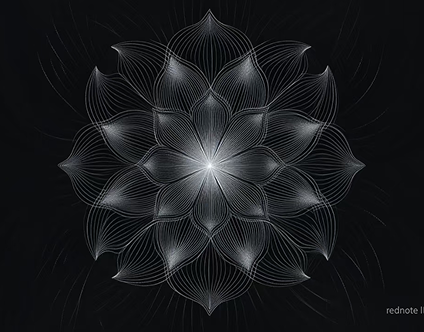
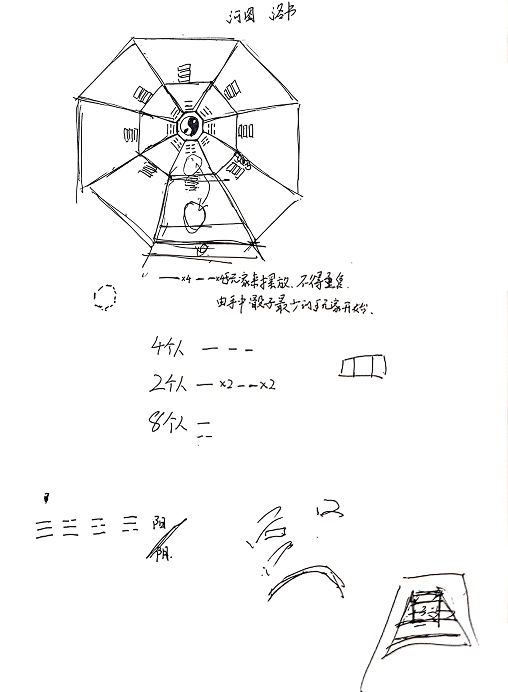
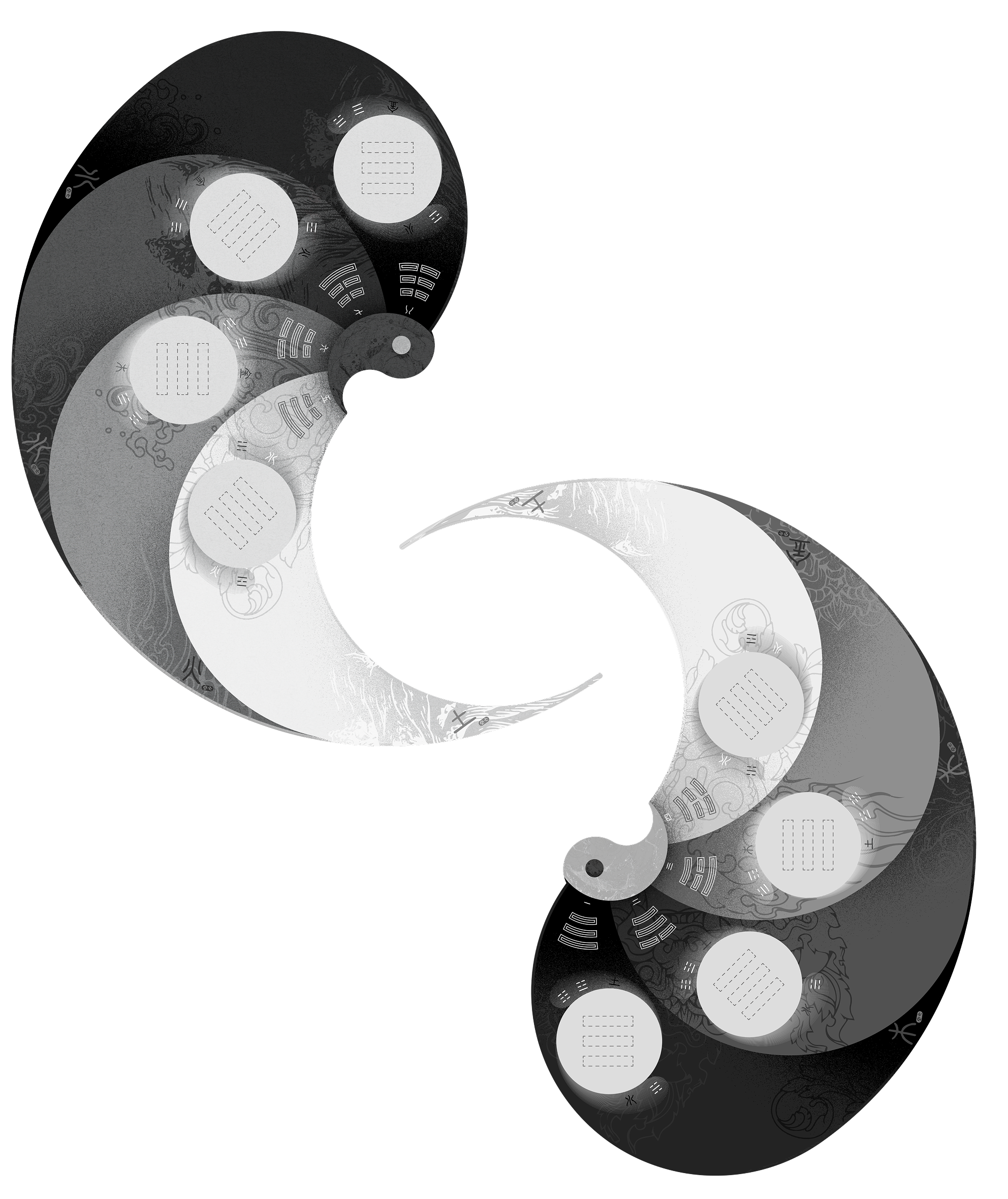
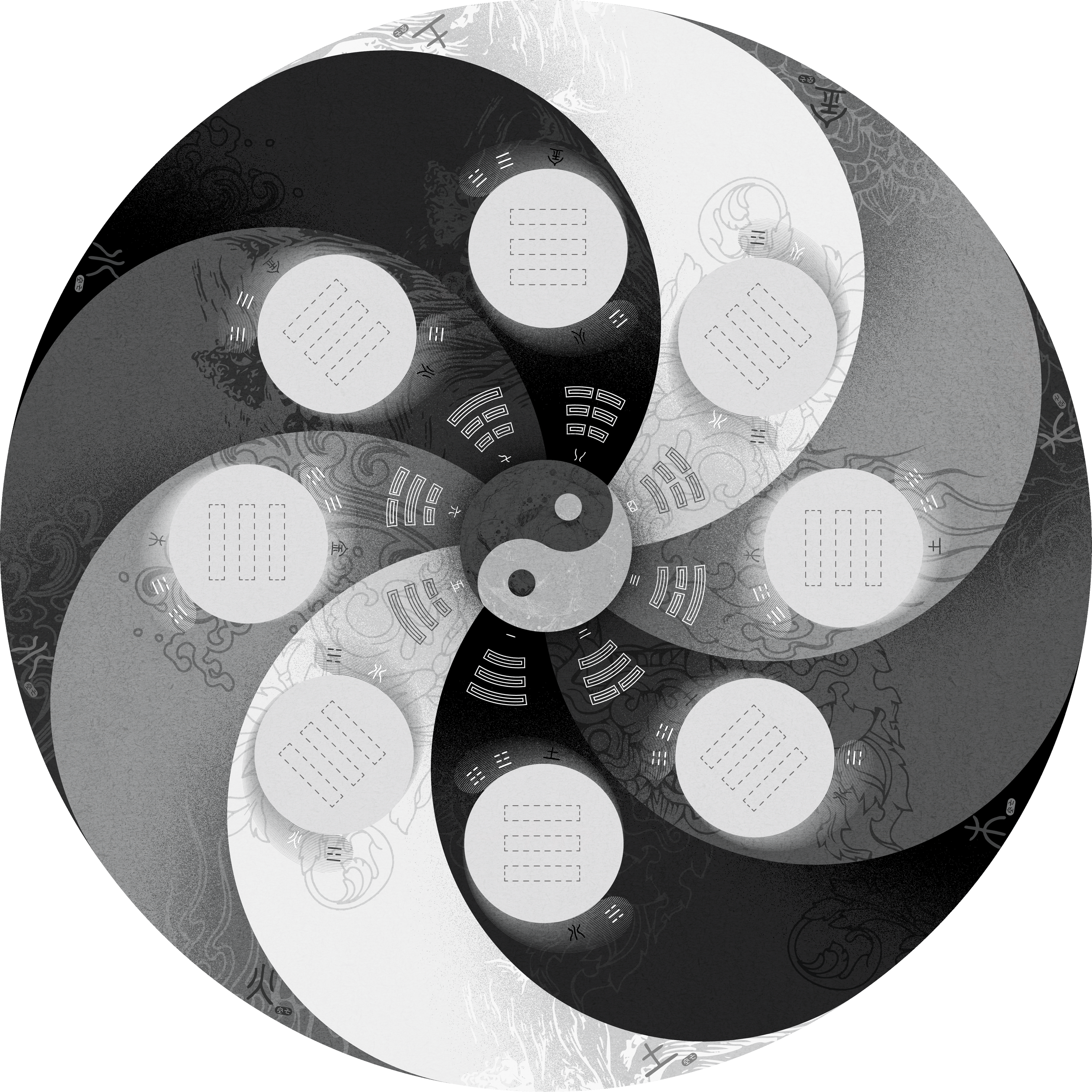
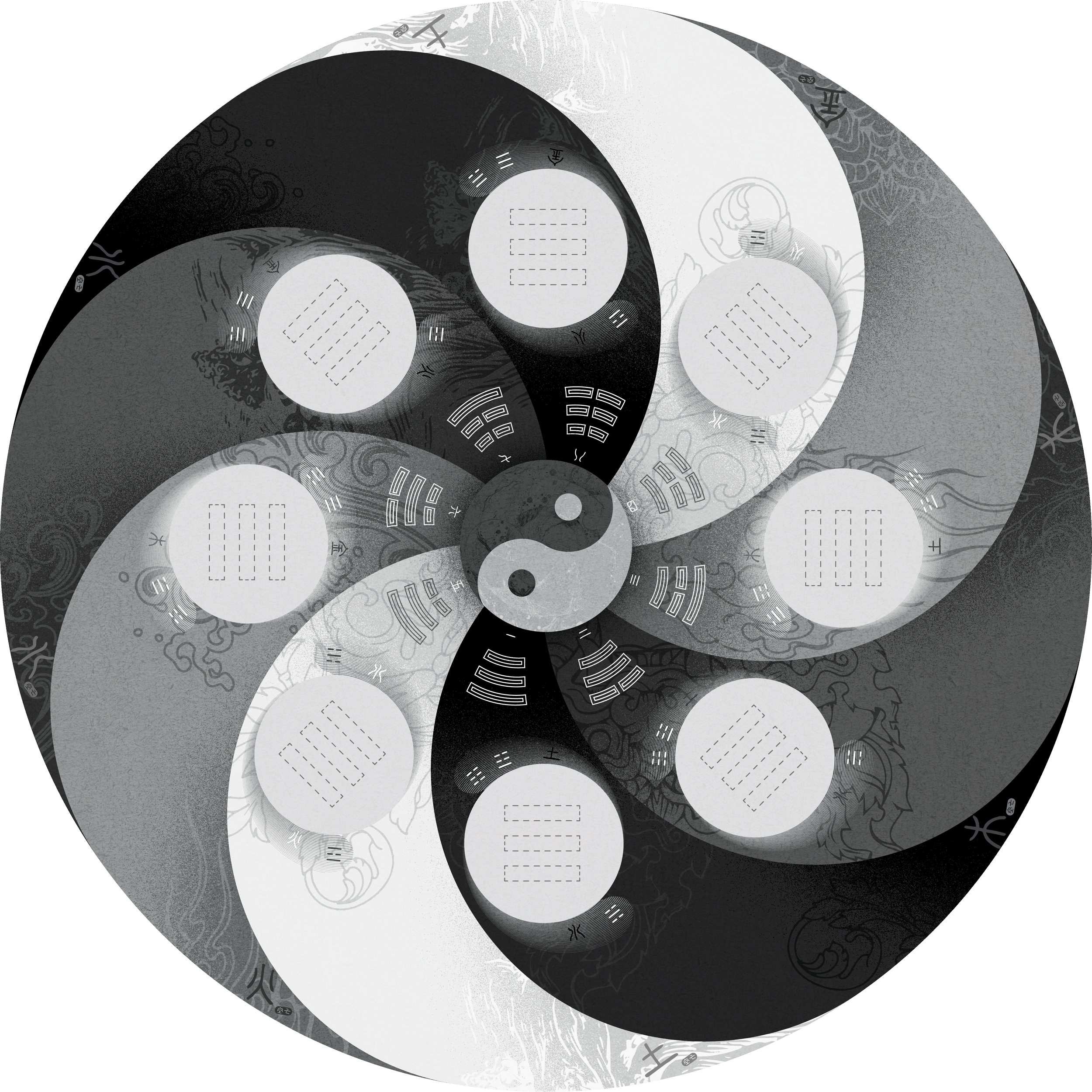
The design began with a traditional Bagua layout—an octagon with basic rings that proved effective in testing. Later, I refined it by experimenting with form, symbols, and colors to retain its cultural essence while achieving a more modern, distinctive look.
Art Display
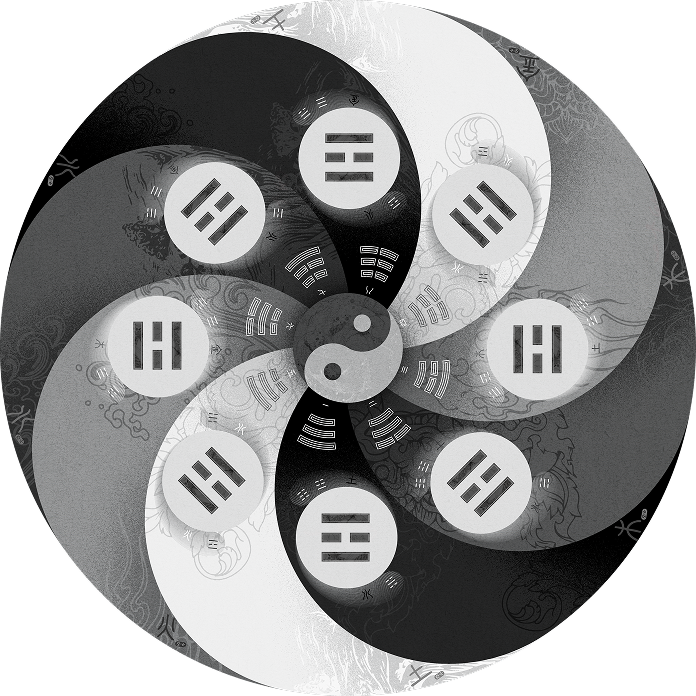
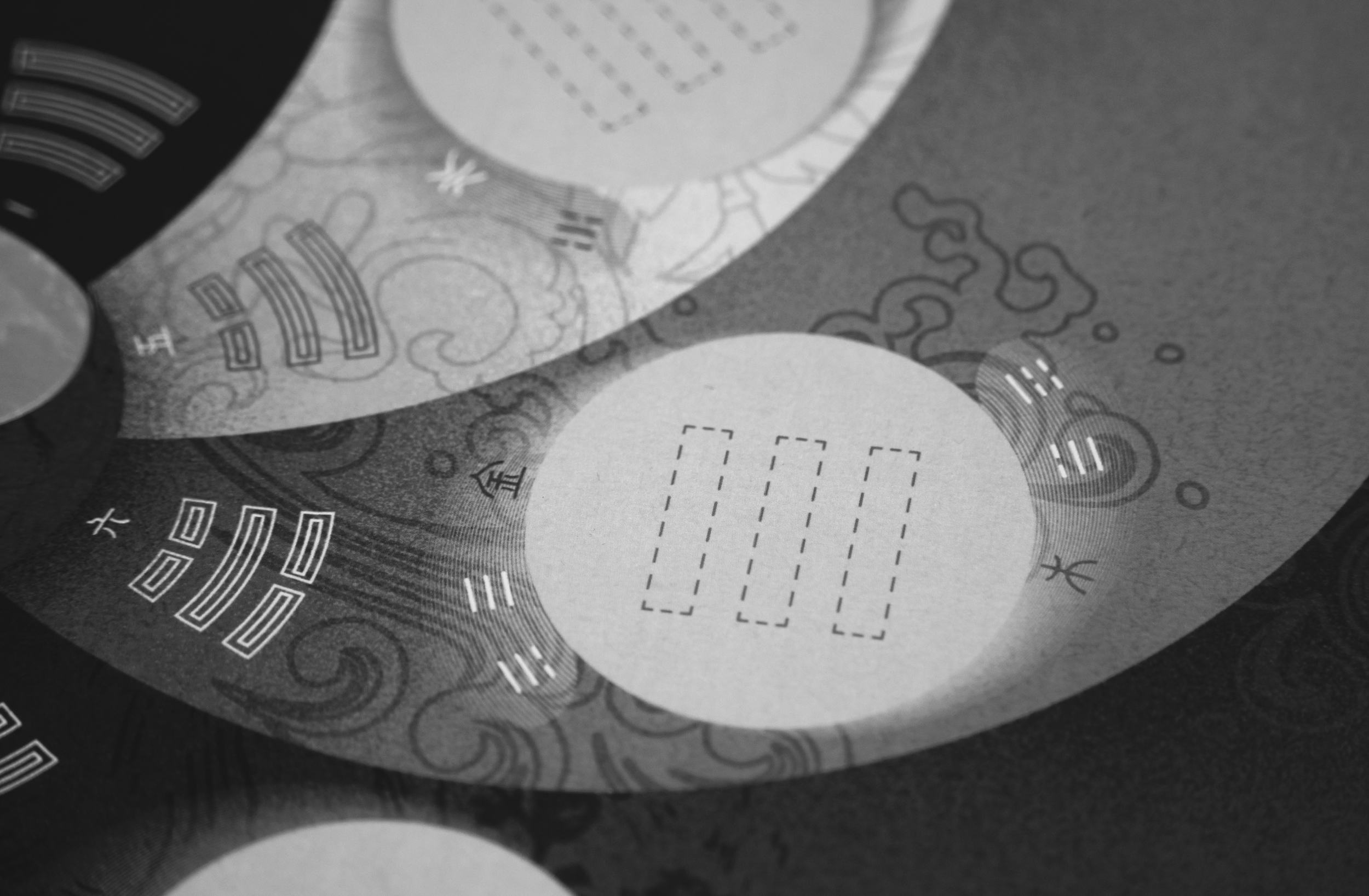
For the second version, I moved away from the color-based approach and adopted a monochromatic palette of black, white, and gray to achieve greater visual harmony. This shift echoed the Bagua’s core philosophy of yin and yang—light and darkness in balance. Instead of color, I used patterns, textures, and motifs to express each element’s qualities, creating a design that felt more refined, culturally resonant, and timeless.

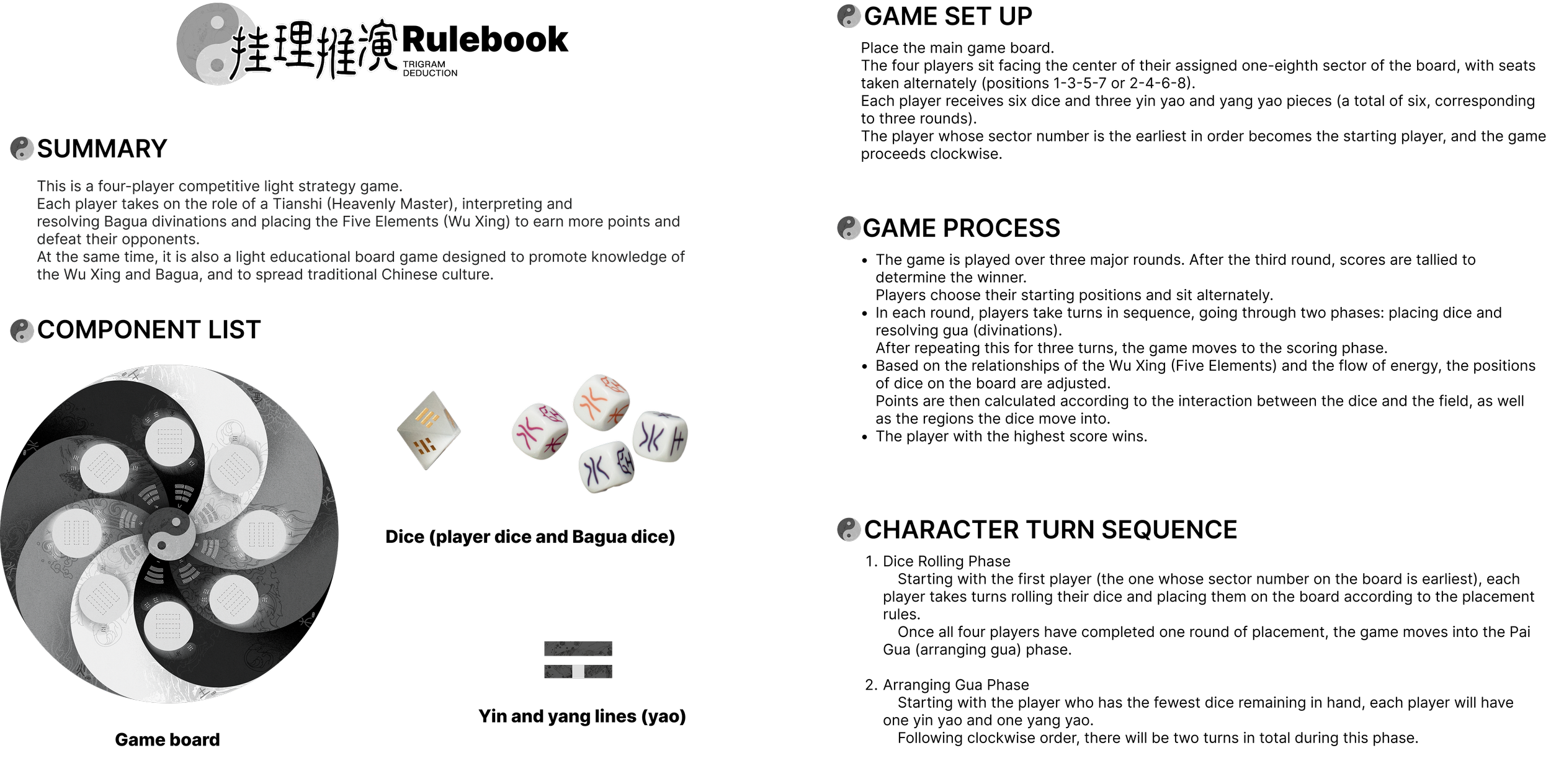
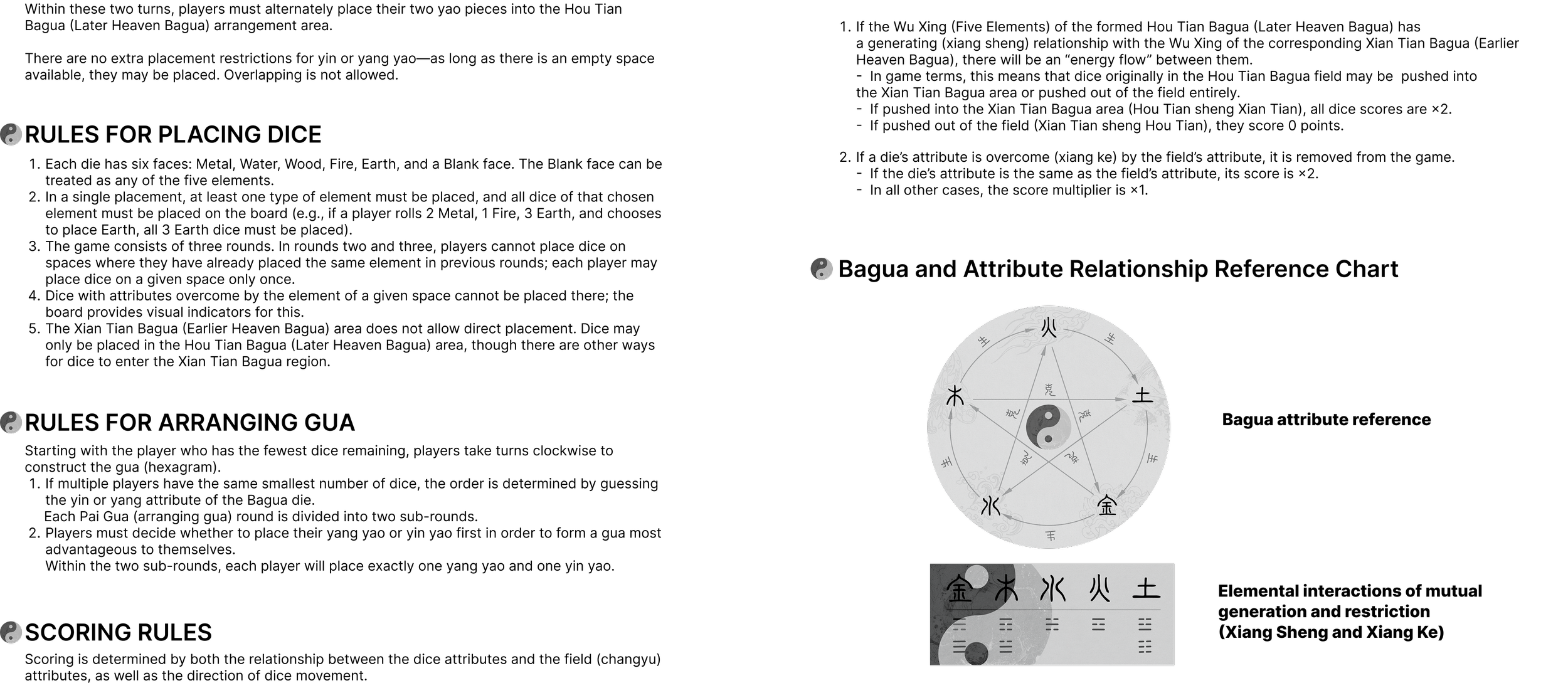
Rule Book